Emotions Aren’t Real
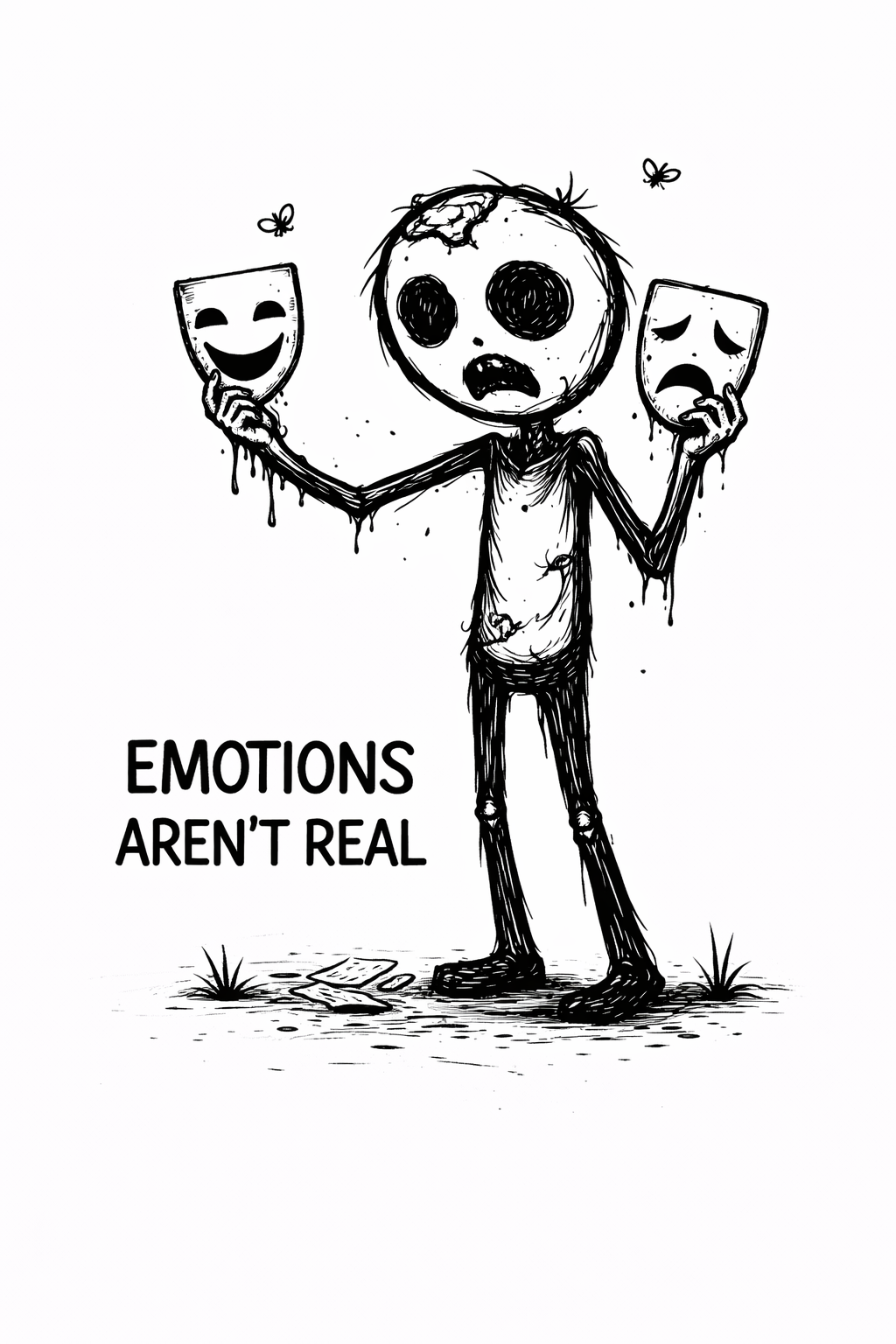
There’s a moment most mornings, right after the alarm goes off and before your mind fully reconnects with your body, where you lie still and register a flood of sensation. Tightness in the chest. A low hum of dread. A flicker of excitement, or resistance, or confusion. The sudden awareness that you exist and that today expects something from you. We usually call this moment “how I feel.” And then we make a mistake. We assume those sensations are things. Discrete objects inside us. Emotions with names, causes, and meanings. Anxiety. Sadness. Motivation. Joy. We talk about them as if they’re entities, real, stable forces moving through us, telling us something important about ourselves or the world.
But what if they aren’t?
What if emotions aren’t things at all, but interpretations? This idea is deeply uncomfortable because modern life is built around the assumption that emotions are real, fixed, and authoritative. We’re taught to identify them, name them, honor them, follow them. We build entire systems of therapy, self-help, wellness, productivity, and identity around the idea that emotions are internal truths waiting to be discovered. Yet decades of cognitive neuroscience suggest something far stranger: emotions are not hardwired experiences that happen to us. They are mental constructions our brains create to explain bodily sensations in context. In other words, your brain doesn’t feel emotions. It guesses them.
Cognitive scientist Lisa Feldman Barrett has spent years dismantling the idea that emotions are universal biological modules, preinstalled programs that activate automatically. Her research shows that the brain is constantly predicting what’s happening in your body and environment, then labeling those predictions using concepts it learned over time. Emotions are not discovered; they are assembled. You don’t feel sadness. You feel a collection of physical sensations, low energy, heaviness, slowed movement, and your brain interprets those sensations as “sadness” because that label has been useful before. The same sensations in a different context might be labeled boredom, exhaustion, or even calm. The feeling didn’t change. The story did. This reframing is destabilizing because it removes the authority we’ve granted emotions. If emotions are constructed, they aren’t objective signals from the universe. They’re hypotheses. Best guesses. Narratives your brain uses to make sense of internal noise. And your brain, it turns out, is not a wise narrator. It’s a pattern-matching machine running on outdated hardware, trained by past experience, culture, language, and habit. It wants coherence more than accuracy. It wants to explain sensations quickly so you can act, not so you can understand truth.
That’s why emotions feel convincing. They’re not random. They’re efficient. Consider how often the same bodily sensation gets different emotional labels. A racing heart could be anxiety before a meeting, excitement before a date, anger during an argument, or panic at night. The physiology overlaps. What changes is context, and the story your brain tells about it. It’s not a flaw. It’s how prediction-based systems work. Your brain evolved to keep you alive, not enlightened. When it detects arousal, it scans memory and environment and assigns meaning fast. Accuracy is secondary to action. The problem is that modern life gives us endless sensation with very little immediate action. We’re overstimulated, sedentary, cognitively overloaded, and socially fragmented. Our nervous systems fire constantly, but there’s rarely a clear physical response to discharge the signal. So the brain keeps interpreting. Keeps narrating. Keeps inventing emotional meaning. And we treat those meanings as gospel.
This is where the emotional economy begins. Entire industries are built on the premise that emotions are things you can manage, heal, regulate, or optimize. Identify your feelings. Name them. Process them. Sit with them. Track them. Journal them. Meditate them into submission. But if emotions are constructions rather than objects, much of this language becomes misleading. You can’t “sit with” something that isn’t a thing. You can’t “process” a story without questioning the narrator. You can’t heal an interpretation without examining the assumptions beneath it. This doesn’t mean therapy is useless or emotions are meaningless. It means we often aim at the wrong target.
Historically, humans didn’t obsess over emotions the way we do now. Early humans experienced bodily states: hunger, pain, fear, fatigue, but they didn’t build elaborate identities around them. A caveman wasn’t “depressed.” He was injured, hungry, isolated, or threatened. His nervous system activated, he acted, and the signal resolved. Modern humans live in abstraction. Threats are symbolic. Rewards are delayed. Survival is mediated through screens. The nervous system evolved for immediate danger, not long-term ambiguity. So it stays activated. And the brain keeps explaining that activation using the emotional vocabulary it has learned. That’s why people feel constantly anxious without knowing why. The body is aroused. The brain looks for a cause. It finds one, work, relationships, the future, the past, and labels the sensation accordingly. The label feels real because it organizes experience. But it may not be accurate. Neuroscientist Antonio Damasio described this sequence clearly: bodily changes come first, interpretation comes second. We don’t feel fear because something is dangerous. We notice bodily arousal and infer danger. The brain is always late to the party, and then insists it planned the whole thing.
This leads to one of the most persistent myths of modern life: emotional honesty. We’re told to “be honest about our feelings” as if emotions are transparent truths waiting to be reported. But if emotions are constructed, emotional honesty becomes something else entirely. It’s not truth-telling. It’s narration. Saying “I feel betrayed” doesn’t mean betrayal occurred. It means your brain interpreted sensations as betrayal. Saying “I feel insecure” doesn’t mean you are inadequate. It means your nervous system is activated and your brain assigned that label. Feelings are not evidence. They’re experiences. This distinction matters because feelings are persuasive. They demand action. They justify behavior. People end relationships, quit jobs, start wars, and reshape lives based on how they feel in a moment, without questioning whether the feeling reflects reality or interpretation. Emotion researcher Joseph LeDoux has emphasized that what we call emotions are layered on top of basic survival circuits. The body reacts first. Conscious meaning comes later. By the time you “feel” something, the machinery is already in motion. Which means emotional certainty is often retroactive.
Culture further complicates this by teaching us how to feel. Emotions are social scripts. We learn which sensations count as anger, which as love, which as grief. We learn when to express them, suppress them, or perform them. Emotional expression varies wildly across cultures, not because human biology is different, but because interpretation is learned. That’s why emotions spread socially. One person’s panic can trigger another’s. One group’s outrage becomes contagious. The emotion isn’t transmitted biologically; the story is.
We also personalize emotions into identities. “I’m an anxious person.” “I’m sensitive.” “I’m passionate.” “I’m dead inside.” But research on personality shows that emotional patterns are highly situational. You’re calm until you’re hungry. Patient until you’re tired. Compassionate until you’re threatened. There is no stable emotional self, only contexts interacting with a nervous system. Emotions aren’t who you are. They’re what your system is doing. The most important realization in all of this is not that emotions are fake, but that they are optional interpretations. You don’t have to believe every story your brain tells. You can notice sensations without immediately labeling them. You can question the narrative before obeying it. That doesn’t mean suppressing emotions. Suppression is still belief, just inverted. It means demoting emotions from rulers to messengers. You listen, but you don’t surrender authority. Treat emotions like weather. Notice them. Describe them accurately. Understand that they change. Don’t build identities, decisions, or destinies around temporary internal states.
This is where freedom enters, not as a feeling, but as a skill. The paradox is that emotions may not be real in the way we think they are, but their consequences absolutely are. People act on emotional narratives every day. Lives are shaped by interpretations mistaken for truths. But once you understand that emotions are constructed, you gain leverage. If experience is built, it can be rebuilt. If meaning is assigned, it can be reassigned. If your brain is telling a story, you can ask whether it’s useful. You are not broken because you feel too much. You are human because your brain is constantly trying to explain itself. Emotions aren’t divine messages. They are special effects. The plot, what you do with them, is still yours. And that recognition, more than any named feeling, is what actually loosens the grip.
That’s agency. Which, unlike emotions, is real enough to matter.