Time zones aren’t real.
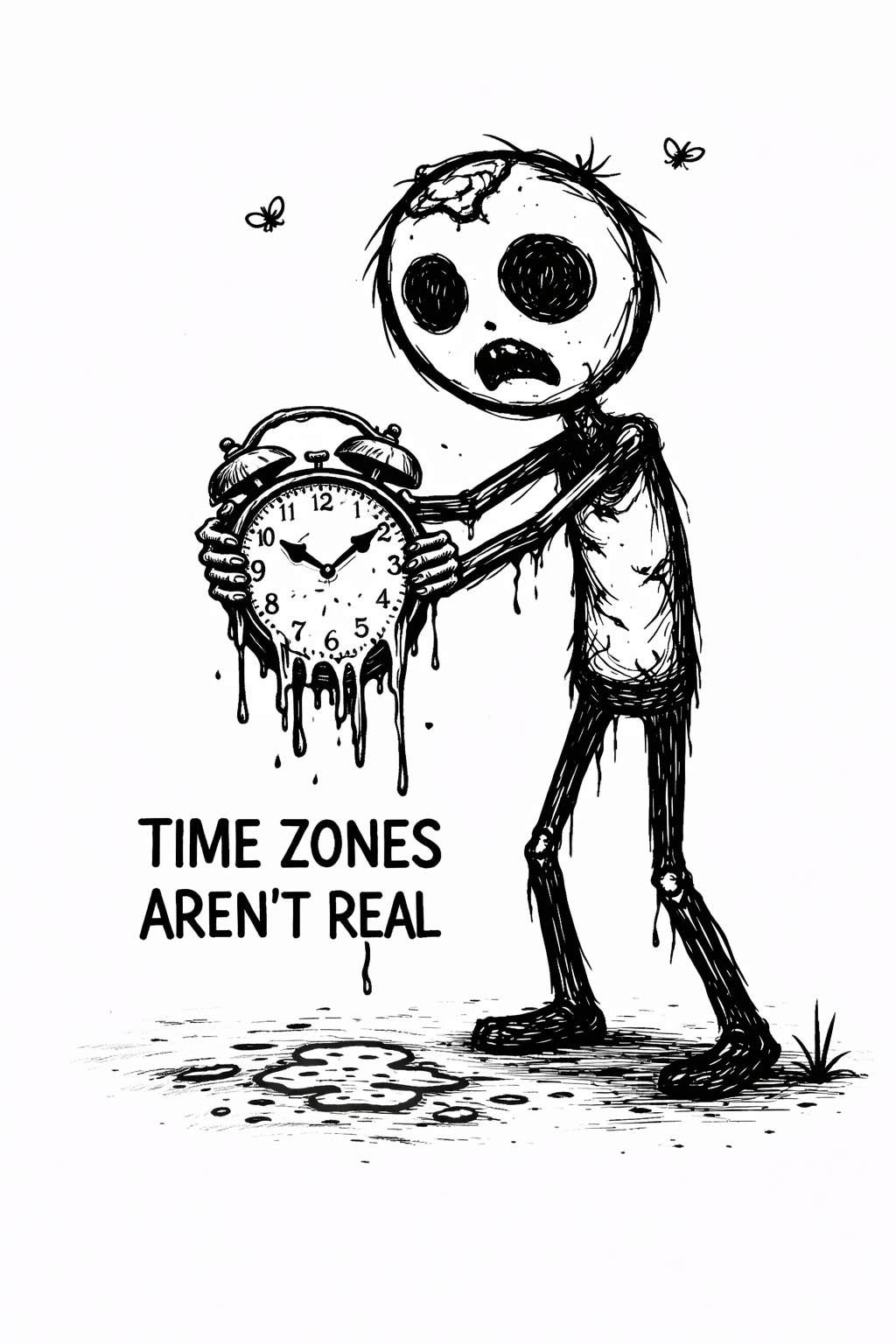
Time zones aren’t real. They feel official, unavoidable, and deeply embedded in daily life, but at their core they’re an agreement, an elaborate, global compromise layered on top of a spinning rock. The Earth doesn’t care what time it is. It never has. It rotates at a steady pace, sunrise to sunset, over and over again, while humans argue about whether a meeting should be scheduled for 9:00 a.m. Eastern or “after lunch your time.” Time zones exist because we decided they should, not because nature demanded them. And the more you think about that, the stranger they become. For most of human history, time was local and approximate. People didn’t need precision because their lives didn’t require it. You woke up when the sun rose, worked while it was high, and stopped when it dipped below the horizon. Noon was when the sun was overhead. Evening was when shadows stretched. If you asked someone what time it was, the answer was essentially, “around now.” And that was good enough.
This system worked remarkably well until humans invented something that refuses to be vague: trains. Railroads needed coordination. Departure times had to line up. You couldn’t run a national network when every town insisted that noon happened slightly differently. When trains entered the picture, “close enough” stopped being acceptable. Schedules demanded standardization, and standardization demanded authority. So in 1884, representatives from around the world gathered at the International Meridian Conference and did what humans tend to do when faced with complexity: they simplified aggressively. The Earth was divided into twenty-four time zones, each roughly fifteen degrees of longitude apart, anchored to a prime meridian running through Greenwich, England. From that moment on, time stopped being local and started being administrative. This was less a discovery than a decision. There was nothing inevitable about it. The planet didn’t insist on twenty-four slices. We chose them because they were tidy, symmetrical, and convenient for paperwork. Time zones didn’t emerge organically; they were imposed for efficiency. And like most systems created for efficiency, they’ve spent the last century creating confusion.
At first glance, time zones seem reasonable. When the sun is up, it’s day. When it’s down, it’s night. Different places experience this at different moments. That part checks out. But once you look closer, the cracks appear. Some countries are offset by thirty minutes. Others by forty-five. Political borders override solar reality. Daylight Saving Time enters the picture and quietly breaks whatever logic was left. India operates on UTC+5:30. Nepal chose +5:45. Not because the sun demanded it, but because nations wanted temporal independence or alignment that felt right politically. Arizona opts out of Daylight Saving Time altogether, while other states shift their clocks twice a year. At one point, parts of Indiana observed Daylight Saving while neighboring counties did not, creating situations where driving a short distance could send you forward or backward in time.
This isn’t a natural system. It’s a negotiated one. And negotiated systems are always messier than we like to admit. Greenwich Mean Time, the global reference point for time, exists largely because Britain had the naval power and influence to make it stick. There’s nothing inherently special about Greenwich beyond history and momentum. We could have chosen anywhere. We didn’t choose the place with the clearest skies, the most dramatic sunsets, or even the most neutral geography. We chose the place with the loudest voice at the table. Once chosen, it became permanent, not because it was perfect, but because changing it would be inconvenient. That’s a familiar story. Many systems persist not because they’re optimal, but because they’re already in place.
One of the stranger consequences of time zones is how they fracture the idea of “now.” At any given moment, it is yesterday somewhere, today somewhere else, and already tomorrow somewhere else entirely. This isn’t poetic; it’s logistical. Someone is waking up while someone else is falling asleep, and someone else is responding to an email that appears to have been sent from the future. This creates a subtle cognitive dissonance. We talk about time as if it’s shared, but it isn’t. “Tomorrow” isn’t a universal concept. “Later today” depends on longitude. Even something as simple as “end of day” becomes ambiguous the moment you leave your own time zone. Modern technology makes this tension impossible to ignore. Global workforces, remote teams, and international communication have turned time zones into daily obstacles. Calendars convert automatically. Clocks adjust silently. Everyone double-checks. No one is fully confident. The system works just well enough to function, and just poorly enough to cause constant low-grade frustration.
Which raises an obvious question: if time zones are this awkward, why do we keep them? Part of the answer is habit. People seem to like their mornings and evenings to line up with daylight. Most of us are used to starting work after sunrise and finishing before dark. Universal time would break that illusion. If everyone used one global clock, some people would start their workday at “14:00” while the sun rose, and others would start at “22:00” in broad daylight. The clock would no longer reflect the sky. But that discomfort is mostly aesthetic. We already decouple clocks from reality every year with Daylight Saving Time. We already accept that “9:00 a.m.” is arbitrary. Universal time wouldn’t change our routines; it would just force us to admit they’re conventions. A single global time would eliminate conversions, reduce scheduling errors, and make international coordination straightforward. No more mental math. No more accidental 3 a.m. meetings. No more apologetic emails explaining that you “mixed up the time zones.” Everyone would speak the same temporal language, even if their days felt different.
This idea isn’t new. Scientists, engineers, and global organizations already rely heavily on UTC. Aviation uses it. Space agencies use it. Computing systems often default to it. The infrastructure exists. What’s missing is the cultural willingness to let go of the idea that the clock must match the sun. And that reluctance says more about us than it does about time. Time zones feel real because they’re enforced. Clocks change automatically. Meetings are scheduled around them. Paychecks depend on them. But enforcement isn’t the same as inevitability. Traffic laws are enforced too, and they’re still human inventions. Money is enforced. Borders are enforced. None of these are natural phenomena. They’re agreements backed by repetition and authority.
Time zones are similar. They’re a story we tell ourselves to stay coordinated. A useful story, but a story nonetheless. The danger isn’t that time zones exist. The danger is forgetting that they’re optional frameworks, not fundamental truths. When systems stop being questioned, they stop evolving. Time zones made sense for a world of trains and telegraphs. They make less sense in a world of instant communication and distributed work. At the end of the day…whenever that happens to be where you are; time zones are a reminder of how much of reality is negotiated. They feel solid because we treat them that way, not because they’re carved into the universe. The Earth keeps spinning, indifferent to our clocks, while we argue over calendars and offsets and reminders.
Time zones aren’t real in the cosmic sense. They’re real in the administrative sense. And like many administrative solutions, they’re both impressive and absurd: a clever fix that outlived the problem it was meant to solve. You don’t need to abolish them to recognize that. You just need to remember that when your meeting runs late, your calendar glitches, or your alarm goes off at the wrong hour, it’s not time betraying you. It’s a system doing its best to organize a planet that never asked to be scheduled in the first place.