Astrology isn’t real.
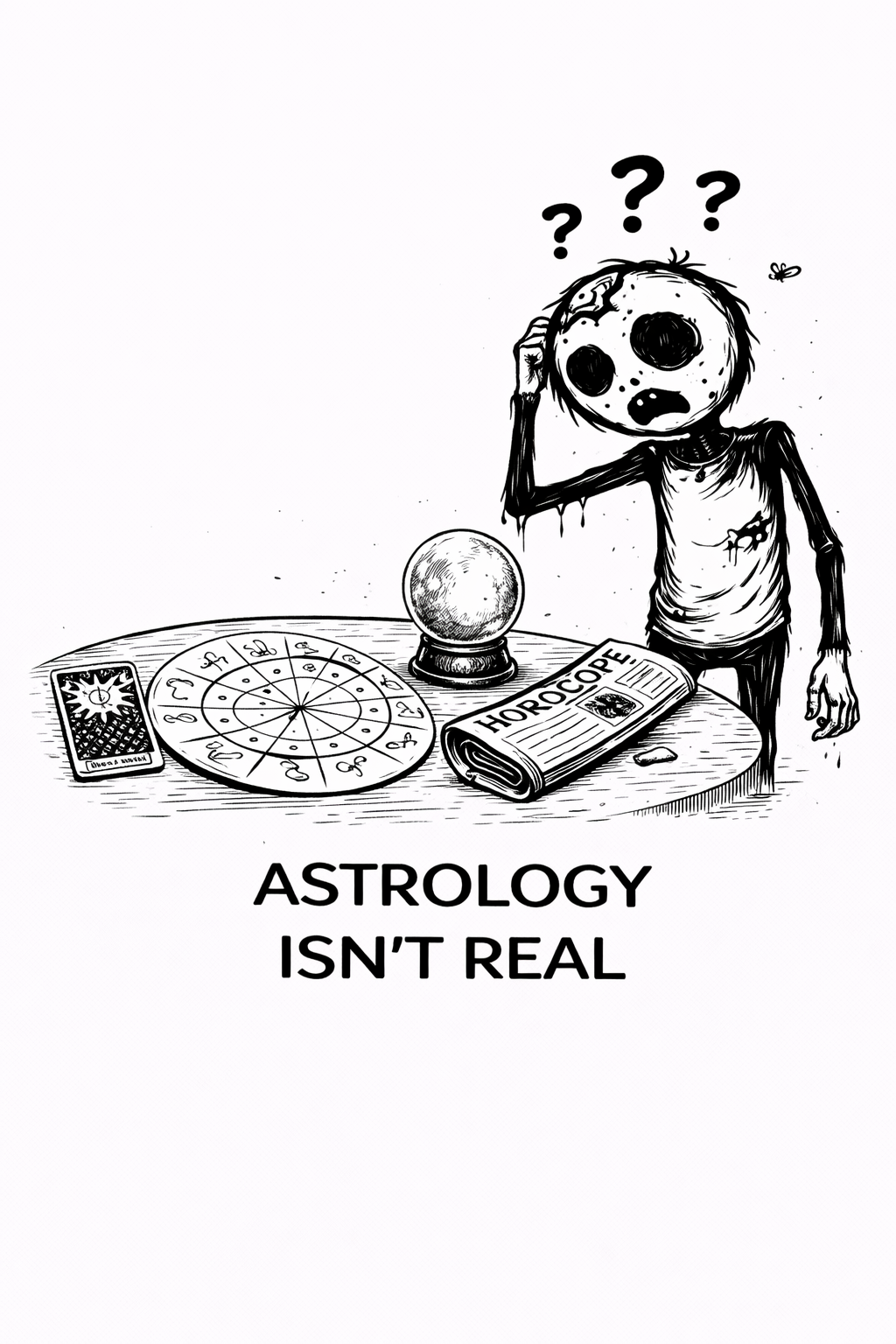
Let’s get something out of the way early, gently, without shouting it from a mountaintop or posting it in all caps on Instagram: astrology isn’t real. The stars are not running your life. Mercury didn’t knock your Zoom call offline. Venus didn’t sabotage your relationship. And Chad didn’t ghost you because his rising sign clashes with your moon sign. Chad ghosted you because Chad is emotionally unavailable and bad at communication. The stars didn’t do that. A man with a phone did.
Still, astrology’s lack of scientific credibility hasn’t stopped it from thriving. In fact, it seems to be doing better than ever. Which tells us something important: truth has never been the sole requirement for popularity. Comfort, entertainment, and a vague sense of meaning will often do just fine on their own. Astrology has been around for thousands of years, long before podcasts, personality tests, or the concept of “working on yourself.” Ancient civilizations looked up at the night sky, an overwhelming, glittering mystery, and decided it must be connected to what was happening down here. That makes sense. Humans have always wanted patterns, and when the world feels chaotic, assigning meaning to something distant and unknowable feels oddly stabilizing. The Babylonians began mapping planetary movements, the Greeks refined the system, and before long we had twelve zodiac signs meant to explain everyone who would ever live. It was ambitious, if nothing else.
The core idea of astrology is that the position of the planets at the moment of your birth shapes your personality and destiny. This is a powerful concept, even if it doesn’t survive scrutiny. Most people are born in busy hospitals under fluorescent lights, surrounded by beeping machines and stressed-out adults. It’s hard to imagine Jupiter pausing mid-orbit to say, “Ah yes, this one will overthink text messages.” But the idea stuck, because it offered something people wanted: a story about themselves that felt bigger than random chance. That’s where the zodiac signs come in. They’re just specific enough to feel personal and just vague enough to apply to almost anyone. Gemini is adaptable and social. Taurus enjoys comfort and routine. Scorpio is intense. Virgo is organized. Pisces is emotional. None of these traits are rare. They’re human. And that’s the point. Astrology doesn’t need to be precise; it just needs to be relatable.
Psychologists call this the Barnum effect: when people interpret broad, general statements as uniquely meaningful to them. Horoscopes are built entirely on this phenomenon. “You may feel conflicted about a decision this week” applies to every adult alive. “Someone from your past may resurface” is just a matter of time. Astrology didn’t predict anything; it simply waited long enough to be right. This doesn’t make it malicious; it makes it clever. Mercury in retrograde is perhaps astrology’s most enduring contribution to modern culture. Every few months, communication breaks down, plans fall apart, and someone reminds you that Mercury is in retrograde, as if that explains everything. Technically, Mercury appearing to move backward is just an optical illusion caused by the relative speeds of planetary orbits. It’s not actually reversing direction. It’s not angry. It’s not targeting your email draft. Mercury does not care about your group chat, your job interview, or the text you regret sending. But blaming Mercury is comforting. It shifts responsibility away from us and onto something vast and untouchable. It’s easier to say “Mercury is in retrograde” than “I forgot to double-check my calendar” or “I avoided a difficult conversation until it became worse.” Astrology offers a low-effort explanation for everyday friction, and people are very receptive to explanations that don’t require introspection.
From a scientific perspective, astrology simply doesn’t hold up. Astronomy is a legitimate field built on observation, mathematics, and repeatable evidence. Astrology shares the same celestial objects but none of the methodology. There’s no credible research showing a connection between birth dates and personality traits, and large-scale studies consistently find no meaningful correlation. Even NASA has gone out of its way to clarify that astrology isn’t part of what they do, which feels like something they shouldn’t have to say but apparently do. There’s also the inconvenient detail that the constellations themselves have shifted over time due to Earth’s axial precession. The zodiac signs are no longer aligned with the stars they were originally based on. Technically, many people are not the sign they think they are. This alone should have collapsed the system, but astrology isn’t sustained by accuracy. It’s sustained by participation. And participation is where astrology shines. It’s social. It’s playful. It gives people a shared language for talking about themselves without getting too deep too fast. Saying “I’m a Virgo” is easier than explaining your anxiety around control and responsibility. Saying “I don’t trust Scorpios” is easier than unpacking your attachment patterns. Astrology functions less like a belief system and more like a conversational shortcut.
It’s also fun. Astrology is essentially the ancient world’s version of a personality quiz. It’s BuzzFeed before the internet. “Which Greek god are you?” “What does your moon sign say about your love life?” “Which crystal will protect you from negative energy and unpaid parking tickets?” The answers are rarely useful, but they are entertaining. And entertainment has always been enough to keep an idea alive. Astrology thrives especially well in uncertain times, which explains its modern resurgence. When the world feels unstable, economically, socially, or emotionally, people look for frameworks that make chaos feel intentional. Astrology suggests that things happen for reasons, even if those reasons are vague and planetary. It offers narrative structure when reality feels disjointed. That doesn’t make it true, but it does make it appealing. There’s also something reassuring about astrology’s low stakes. Unlike rigid belief systems that demand obedience or sacrifice, astrology asks very little of you. You can believe in it casually. You can laugh at it while still checking your horoscope. You can use it as a joke and a coping mechanism at the same time. It doesn’t punish disbelief. It just waits patiently to be rediscovered during a breakup.
The real danger isn’t believing astrology is fun or interesting. The danger is outsourcing too much agency to it. When people start making serious life decisions based on horoscopes, who to date, when to quit a job, or whether to trust someone, they’re no longer using astrology as entertainment. They’re using it as a substitute for judgment. That’s when a playful idea becomes a crutch. Astrology isn’t responsible for your bad decisions, but it can become a convenient alibi for avoiding accountability. It’s easier to say “the timing wasn’t right astrologically” than “I wasn’t ready.” It’s easier to say “we weren’t compatible signs” than “we didn’t communicate.” The stars make an excellent scapegoat because they can’t argue back.
And yet, despite all of this, astrology endures. Not because it’s accurate, but because it’s human. Humans like stories. Humans like categories. Humans like feeling understood, even if the understanding is a little fuzzy around the edges. Astrology gives people a way to talk about identity, emotion, and uncertainty without requiring a deep dive into neuroscience or philosophy. It’s shorthand for complexity. Astrology isn’t real in the scientific sense. It doesn’t explain the universe, predict behavior, or reveal hidden truths about your destiny. But it is real in the cultural sense. It’s a shared myth, a playful lens, a language people use to make sense of themselves and each other. Like many things humans invent, it says more about us than it does about the world.
Believe in astrology if it brings you joy. Read your horoscope if it makes your morning more interesting. Joke about Mercury in retrograde when everything goes sideways. Just don’t surrender your agency to it. Don’t let it replace self-awareness, effort, or responsibility. The stars aren’t running your life. They never were. Astrology is a story we tell ourselves, sometimes thoughtfully, sometimes lazily, sometimes just for fun. And like most stories, it works best when you remember that it’s a story.