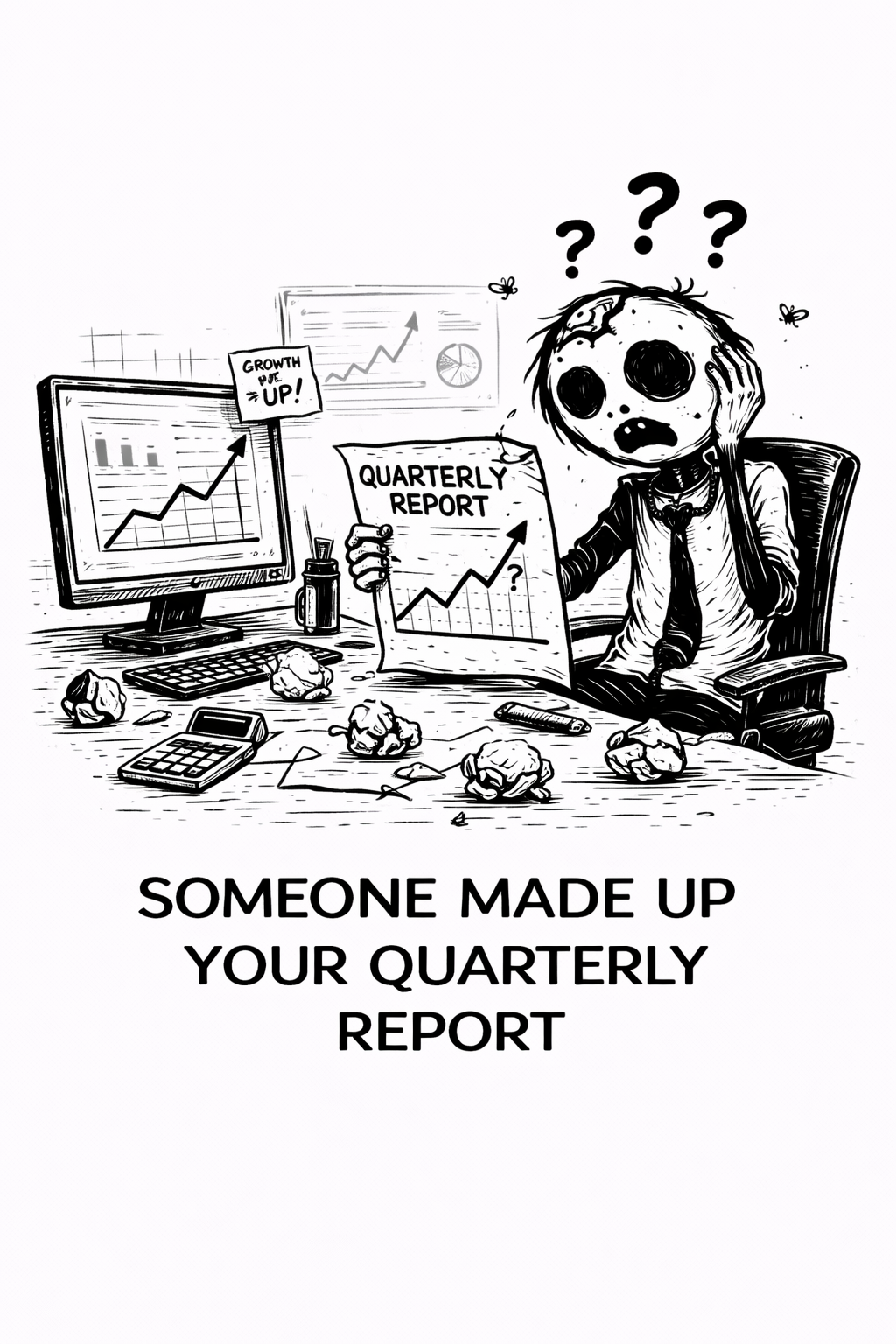
Someone made up your quarterly report.
Someone Decided Work Needed Theater
At some point, a group of adults decided that work needed theater. Not just tasks or outcomes, but rituals. Slides. Dashboards. Charts. Words that sound serious enough to discourage questions. And from that moment on, the quarterly report was born, a document so powerful that entire careers now orbit it, despite no one being fully sure what it actually measures. The quarterly report feels real because it’s treated as real. People prepare for it. Stress over it. Lose sleep because of it. Entire weeks disappear into “aligning” it. But strip away the formatting, the acronyms, the stock photos of diverse people pointing at laptops, and what’s left is a story. A narrative. A curated explanation of what happened, why it happened, and why it was either very good or secretly good but misunderstood.
Someone made it up. Quarterly reports don’t exist in nature. No animal pauses every ninety days to review its performance against last quarter’s objectives. No river produces a deck explaining why flow was down 3% due to headwinds. This is a uniquely human invention, an attempt to impose narrative order on systems that are mostly chaotic, reactive, and driven by variables no one fully controls. But chaos doesn’t look good in a meeting. So we invented metrics.
Metrics, KPIs, and the Illusion of Control
KPIs are where the real magic happens. Key Performance Indicators sound empirical, almost scientific. They imply that reality has been distilled into something measurable and objective. In theory, KPIs help organizations focus on what matters. In practice, they help organizations focus on what can be easily counted. Revenue growth. Engagement. Utilization. Conversion. Velocity. Retention. Churn. Synergy. Pipeline. Alignment. These words feel solid. They create the illusion that work moves in a straight line from effort to outcome. But most of the time, KPIs are proxies, stand-ins for things we can’t directly measure, like value, impact, learning, or long-term health. So we measure what’s convenient and pretend it’s meaningful.
Once a KPI exists, it becomes a target. And once it becomes a target, it stops being a good measure. Economists call this Goodhart’s Law. In business, it’s just called performance management. People optimize for the metric, not the reality the metric was supposed to represent. Engagement becomes clicks. Productivity becomes visible busyness. Alignment becomes agreement theater.
The report doesn’t tell you what happened, it tells you what can be defended.
That’s where jargon steps in to do its real job. Business language isn’t designed to clarify; it’s designed for insulation. It replaces uncertainty with familiarity. When someone says “we’re seeing headwinds in the back half of the quarter,” no one asks what that actually means, because it sounds like something that happens to serious companies. Weather metaphors are especially useful because they absolve responsibility. No one caused headwinds. They just arrived.
“Opportunity areas” aren’t problems. “Challenges” aren’t failures. “Resource constraints” aren’t poor planning.
Language isn’t describing reality here. It’s padding it until it fits neatly into a slide. That’s why reports are always late but somehow never unfinished. The numbers are locked. The story is still being adjusted.
Reporting as Reassurance, Not Truth
The quarterly report isn’t really about informing leadership. It’s about reassuring it. It answers the question no organization wants to ask directly: Are we still in control? The answer is almost always “yes, with some caveats,” regardless of what actually happened.
Because admitting uncertainty is dangerous.
Business culture treats certainty as professionalism. Saying “we don’t know yet” feels irresponsible, even when it’s the most accurate answer available. So reports are filled with confident projections, directional trends, and forward-looking statements that sound predictive but are mostly extrapolation dressed up as insight.
Forecasts are especially revealing. They assume the future is a continuation of the recent past, adjusted slightly for optimism or caution depending on leadership’s mood. When forecasts are wrong—as they usually are—the explanation is never that forecasting is fundamentally unreliable. It’s that something unexpected occurred. Externalities. Market conditions. Consumer behavior. The economy. Always nouns. Rarely accountability.
This isn’t because people are lying.
It’s because the system rewards coherence, not truth.
Superfluous reporting thrives because it creates the appearance of rigor without the discomfort of interrogation. A 40-slide deck feels more legitimate than a one-sentence truth. “We tried some things. Some worked. Some didn’t. We learned a bit. Next quarter will also be uncertain.” That sentence would be accurate. It would also end the meeting immediately, which is unacceptable.
So instead, we get graphs.
Graphs are persuasive because they turn time into meaning. A line going up feels good. A line going down feels bad. It doesn’t matter what the line represents or whether the change is meaningful. The visual does the emotional work. This is why dashboards are so popular. They give the feeling of oversight without requiring immersion.
Red. Yellow. Green.
On track. At risk. Off track.
Reality reduced to traffic signals so no one has to ask uncomfortable follow-up questions.
Quarterly reports also manage memory. Organizations forget quickly. Reports create an official version of events that can be referenced later—not to understand what happened, but to explain why whatever happened next was inevitable. Once it’s written into the report, it becomes history. Accuracy is optional. Record-keeping is not.
This is why people argue over wording instead of substance. Language becomes the battlefield because whoever controls the phrasing controls the past.
Underneath all of this is a deeply human fear: being seen as unproductive. In knowledge work especially, outcomes are abstract and delayed. You can’t always point to a finished object and say, “I made that.” So you document. You track. You report. Activity becomes a substitute for impact.
Meetings become inputs.
Slides become proof.
Metrics become morality.
If it wasn’t reported, did it happen?
If it wasn’t tracked, did it matter?
This is how people end up spending more time reporting work than doing work, while sincerely believing the reporting is the work. Once enough people believe that, the belief becomes operational truth.
Quarterly reports also protect hierarchy. Decisions can be justified without explanation. “The numbers indicate” ends conversations before they start. Numbers feel neutral, but every metric is a choice. Every report reflects priorities. What’s excluded is often more revealing than what’s included.
Questioning the report starts to feel like questioning reality itself, even when everyone in the room knows the data is incomplete, lagging, or misaligned with lived experience. So people nod. They align. They ask clarifying questions that clarify nothing.
The quarterly report survives not because it’s accurate, but because it’s useful. It allows organizations to move forward without resolving ambiguity. It converts uncertainty into process. And process feels safe.
But none of this is inevitable.
Someone invented quarterly reporting. Someone decided ninety days was the correct unit of meaning. Someone chose which KPIs mattered. Someone decided which words sounded professional enough to survive scrutiny. Everyone else inherited it and mistook it for reality.
This doesn’t mean measurement is useless. Reflection matters. Metrics can help. But when reporting becomes ritual instead of inquiry, it stops serving the organization and starts serving itself.
A healthier version of work would treat reports as tools, not verdicts. As questions, not answers. As approximations, not truths. It would allow uncertainty. It would reward clarity over confidence. It would value learning more than alignment.
That would require admitting something most organizations resist with impressive consistency:
We are making this up as we go.
The quarterly report isn’t real.
The KPIs are not laws of nature.
The jargon is not wisdom.
They are collectively agreed-upon symbols designed to make work feel controllable.
Once you see that, the report loses its mystical authority. It becomes what it always was: a story about work, told by people trying to sound certain inside an uncertain system.
You still do your job.
You still care about outcomes.
You just stop confusing the performance of control with actual understanding.
Someone made up your quarterly report.
And realizing that doesn’t make you less professional.
It makes you more honest.