Someone made up everything you know.
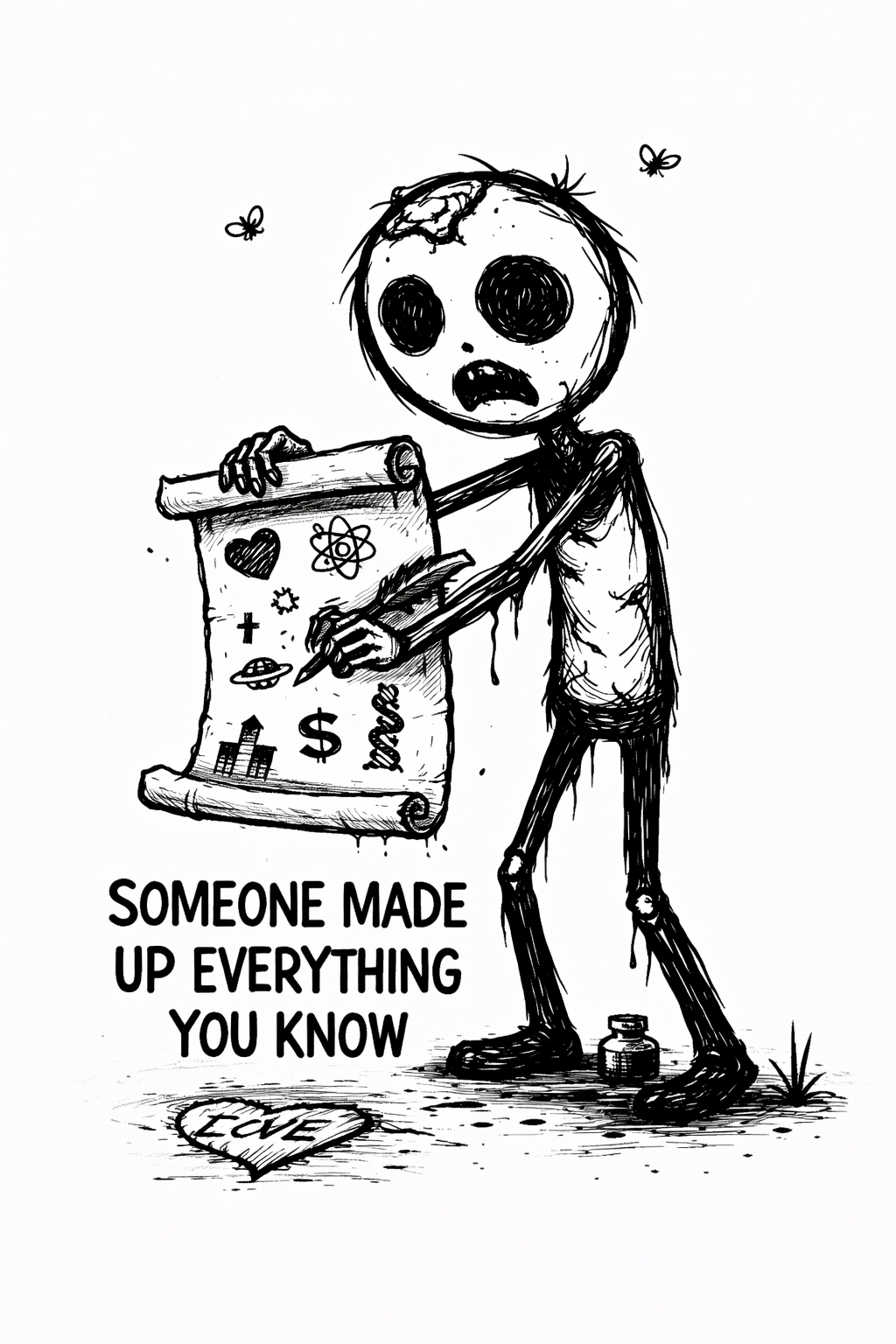
Someone Made Up Everything You Know
Someone, at some point, looked at a chaotic, indifferent universe and said, “Okay, but what if we called this success, that failure, this appropriate, that insane, and everyone agreed to pretend it was obvious?” And everyone else nodded, because the alternative was staring into the sun and admitting nobody was in charge.
That’s how we got here. That’s how you got here. That’s how your calendar, your job title, your sense of progress, your shame, your ambition, your anxiety, and your belief that you are “behind” were quietly installed without your consent.
Someone made it all up. And then they charged admission.
At first, this is funny. It’s funny in the way it’s funny to realize pants are just socially approved leg curtains, or that time zones are a gentleman’s agreement enforced by Outlook. It’s funny to realize the rules feel sacred only because everyone else is acting like they are. It’s funny until you notice how much of your life you’ve been organizing around things that do not exist in nature and never did.
Then it gets darker.
Because once you see how much is invented, you can’t unsee how aggressively it’s enforced. Money is a shared hallucination. Borders are lines drawn by tired men with maps. Job titles are costumes with email signatures. Confidence is a posture. Productivity is a moral system disguised as a spreadsheet. Success is a narrow story told loudly by people who benefited from its definition. Even time, the thing we swear is real because it hurts, has been sliced, labeled, optimized, and weaponized against anyone who dares to move too slowly. Sociologist Peter L. Berger explained this decades ago: societies create institutions, then forget they created them, then punish people for not obeying them. First we build the stage. Then we pretend it’s the ground. Then we tell people they’re failing at gravity. This blog exists because once you realize everything is made up, you face a choice. You can either panic, dissociate, or finally breathe.
Most people panic.
They cling harder to the rules. They double down on rituals. They defend systems that actively exhaust them because the idea that nothing underneath is guaranteed feels worse than exhaustion. It’s safer to believe the ladder is real than to admit you’ve been climbing scenery. But there’s another option, one that doesn’t get sold nearly as well because it doesn’t fit in a five-step framework or a productivity podcast. You can recognize the construction and still choose what to do with it. You can stop confusing what is invented with what is inevitable. You can stop outsourcing meaning to systems that were never designed to care whether you were alive inside them. Historian Yuval Noah Harari points out that humans are uniquely capable of organizing around shared myths. That’s not an insult. It’s a survival trait. Stories let large groups cooperate. The problem starts when the stories harden into prisons and anyone who questions them is treated like a malfunctioning appliance.
Most of us were raised inside these myths so early that they feel biological. You don’t remember learning them. You remember discovering them, like gravity or weather. You learn what a “good life” looks like before you learn how to sit still. You learn what’s respectable before you learn what you want. You learn what counts before you learn who decides. And if you never question it, you can live an entire life performing competence inside a system you never agreed with, quietly blaming yourself for the discomfort it causes. This is where the humor fades and the unease creeps in. Because recognizing that everything is made up doesn’t just dissolve external rules. It destabilizes internal ones too. The voice in your head that says you’re late, behind, unproductive, unimpressive, or wasting time does not come from nature. It comes from inherited frameworks that confuse compliance with worth.
Philosopher Michel Foucault spent his career mapping how power hides inside norms rather than laws. You don’t need a cop if the rules live in your nervous system. You don’t need a prison if people police themselves. You don’t need force if shame does the work quietly and efficiently. Once you see this, you can feel it everywhere. In meetings that exist to prove seriousness rather than accomplish anything. In productivity tools that turn attention into guilt. In lifestyles sold as freedom that somehow require constant optimization and surveillance of the self. In the strange way rest feels illegal unless you earn it first.
This blog is not here to tell you to burn it all down. That’s lazy. Destruction without understanding just creates new myths with better branding. The goal is not to pretend systems don’t exist. They do. The goal is to stop pretending they are sacred. Recognizing that everything is made up is not nihilism. It’s clarity. It allows you to ask better questions. Who made this? Why did it make sense at the time? Who does it benefit now? Who does it exhaust? What problem was it solving, and is that problem even real anymore? What happens if I partially opt out without pretending I’ve transcended it?
These are expert-level questions. And that’s intentional.
Joshua Palms is not about rejecting expertise. It’s about rescuing it. Somewhere along the way, “expert” became a costume anyone could wear who yelled loud enough. Algorithms flattened credibility. Confidence replaced competence. Volume replaced depth. And people learned to trust whoever sounded the least uncertain, regardless of whether they understood what they were talking about. That’s how you end up with gurus selling certainty in a world that requires nuance. Real experts are dangerous to made-up systems because they know how fragile they are. They understand context. They know the history. They can tell you not just what exists, but why it exists and when it stops working. They’re less interested in authority and more interested in accuracy. They don’t need to sell you a lifestyle because they’re too busy explaining trade-offs.
Joshua Palms exists to create space for that kind of thinking. To slow things down enough to examine the scaffolding. To treat ideas like objects you can walk around instead of commandments you must kneel to. To separate “this was invented” from “this is useless,” because those are not the same thing. Some inventions are brilliant. Some are outdated. Some were always bad. Some were good until they were scaled past their purpose. The danger is not invention. The danger is unconscious obedience. This is why the tone shifts here. Because once you understand how much is made up, you start noticing how often people are crushed by rules that were never designed for humans in the first place. You see burnout reframed as personal failure instead of systemic mismatch. You see anxiety marketed as motivation. You see entire identities built around keeping up with moving goalposts that no one agreed to. You also see possibility.
If money is made up, it’s a tool, not a god.
If time is segmented, you can question the segments.
If success is defined, it can be redefined.
If norms are constructed, they can be renegotiated.
That doesn’t mean consequences disappear. It means choices become visible. This blog is a map of those choices. Each post takes something that feels inevitable and asks where it came from. Not to mock it, though humor helps, but to understand it well enough to decide how much power it deserves in your life. Pants. Confidence. Productivity. New Year’s. Identity. Stability. None of these are fake in the sense that they don’t affect you. They’re fake in the sense that they’re optional frameworks pretending to be laws. Once you see that, freedom doesn’t look like rebellion. It looks like discernment.
You stop asking, “Is this allowed?” and start asking, “Is this useful?”
Joshua Palms is not here to sell you a new belief system. It’s here to interrupt the ones you inherited long enough for you to inspect them. To promote real expertise over confident noise. To trace ideas back to their origins instead of treating them like natural facts. To help you make informed, intentional decisions rather than default ones. Everything you know was made up by someone trying to solve a problem in a specific context at a specific time. You are allowed to ask whether that problem is still yours.
That’s the invitation.
And once you see it, you won’t be able to unsee it.