Career Paths Aren’t Real
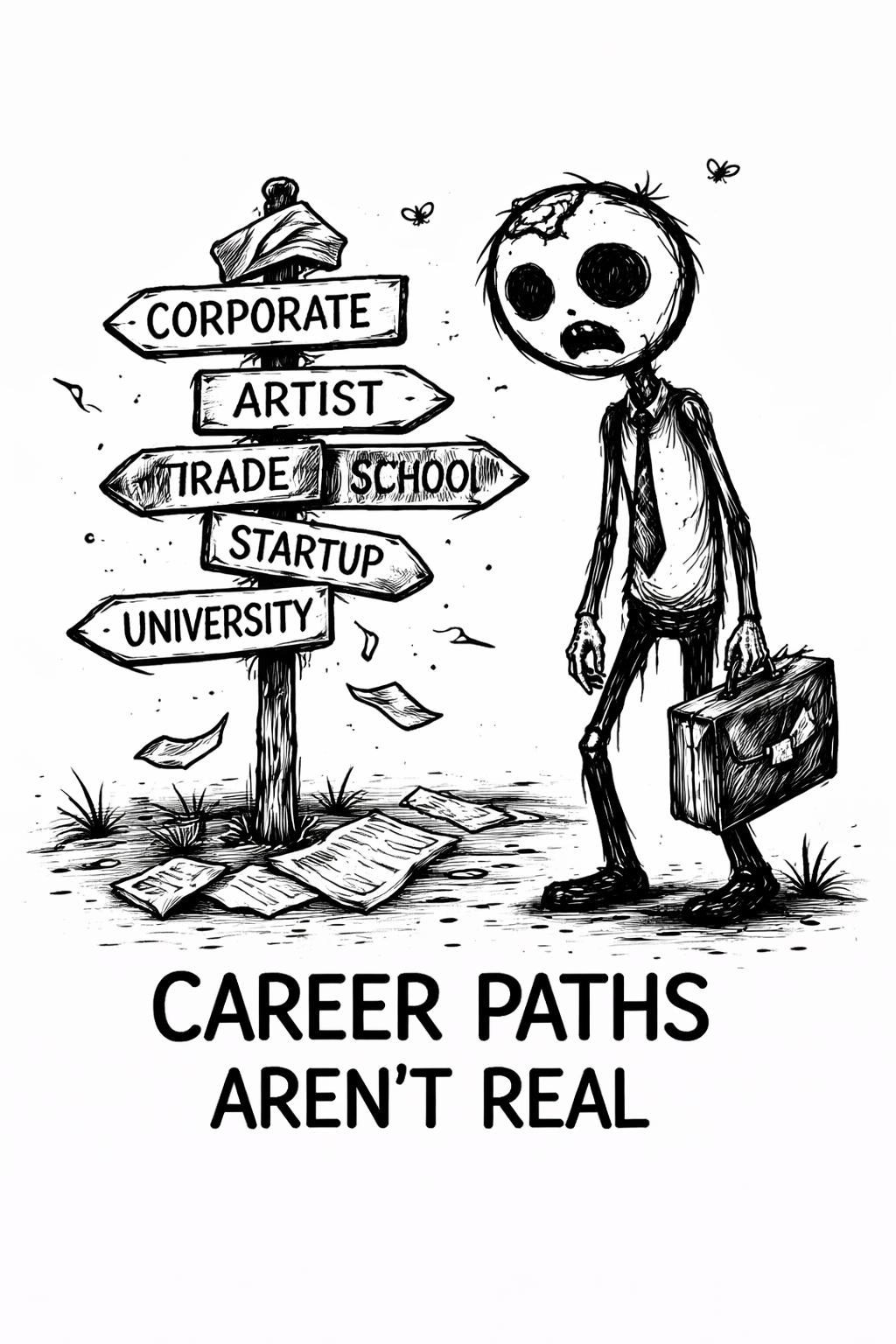
There’s a phrase adults love to throw at children: “What do you want to be when you grow up?” It sounds harmless, even supportive, but it sneaks in a dangerous assumption. That being is a job description. That adulthood is a destination you arrive at fully formed, instead of a lifelong improv performance where everyone forgot the script and the set is on fire. Still, we answer the question. We pick something. We declare a career path the way people used to declare allegiance to kings. We choose a direction and panic-walk down it for forty years, hoping momentum counts as meaning. The whole concept is adorable in a tragic way. Career paths are the horoscopes of capitalism. They predict nothing, explain nothing, and require belief to function.
Career Paths Were Invented for People Who Needed Permission to Exist
Before capitalism, career planning was refreshingly simple. You were a hunter, a gatherer, a farmer, or dead. That was the original decision tree. No networking events. No résumés written under fluorescent lights while your nervous system leaked cortisol. Then industry arrived, and humans became interchangeable parts. You fit into a slot or you starved.
Psychologist Barry Schwartz later called this “the tyranny of choice.” You can be anything now, which conveniently makes failure feel personal. So we invented systems to manage the anxiety. LinkedIn endorsements. Personality tests. Career coaches named Trevor. Five-year plans that collapse within five minutes of contact with reality. These tools don’t provide clarity; they provide comfort. They give structure to confusion. Nobody knows what they’re doing, but now we have spreadsheets about it.
Most people don’t choose jobs because they feel called. They choose them because bills exist. Because their parents needed a win. Because a guidance counselor looked disappointed. Because they panicked in college. Because someone offered benefits. Because the interview didn’t feel like prison. Survival mode wears business casual, and we call that purpose. We romanticize the decision after the fact, pretending it was intentional instead of reactive. But strip away the story and what’s left is fear with a dress code. Careers often aren’t about passion; they’re about minimizing regret and maximizing approval. It’s not destiny. It’s triage.
The Slope Is Slippery and Paved With Buzzwords
You start “entry level,” which sounds humble and hopeful. Then you climb. Your responsibilities grow. Your LinkedIn headline metastasizes into something unrecognizable. Suddenly you are an “innovative, passionate, self-motivated multidisciplinary thought leader.” Translation: you reply to emails quickly and cry in the bathroom silently.
Career progression is marketed as growth, but it usually looks like more responsibility, slightly more money, and increasingly unstable mental health. Leadership is just when the crying gets scheduled. You don’t feel fulfilled; you feel booked. You don’t feel proud; you feel necessary. And necessity is not the same thing as meaning.
Specialization Is Just Self-Inflicted Tunnel Vision
Career paths demand focus, which sounds virtuous until you realize what it costs. Curiosity gets narrowed. Creativity gets sterilized. You become a brand instead of a person. You learn to say you’re “focused” when what you really mean is afraid to wander.
Harvard researcher Todd Rose has argued that linear careers don’t match nonlinear humans. The brain isn’t designed to do one thing forever. It’s a chaos gym built to lift heavy “what if” thoughts. But career paths reward predictability, not exploration. They want you optimized, not alive. They want consistency, not growth.
At a certain point, fulfillment quietly exits the conversation. The goal becomes promotion, prestige, performance reviews, and pretending you enjoy quarterly planning. You start managing people, budgets, expectations, and your worsening urge to flee into the forest and change your name.
Eventually, something unsettling happens. You become the system that stressed you out. You enforce the rules you once hated. You schedule the meetings you once feared. You are no longer trapped in the office. You are the office. Congratulations.
You Aren’t Burned Out, You’re Underwhelmed by the Plot
Burnout isn’t exhaustion. Burnout is boredom with consequences. It’s the soul staging a union strike and saying, “This storyline sucks. Write a new one.” But instead of listening, we optimize. We buy planners. We drink iced anxiety. We download meditation apps. We pray the weekend resurrects us.
Burnout persists because the problem isn’t rest. It’s relevance. You don’t need a vacation. You need a rewrite.
Careers promise meaning, but meaning doesn’t appear in job descriptions. Meaning shows up when you choose curiosity over compliance, building over waiting, questioning over performing. Philosopher Alan Watts put it simply when he said it’s better to live a short life doing what you love than a long one spent miserably. Human resources departments have yet to endorse this philosophy.
Purpose is not assigned. It’s constructed. It emerges when you stop asking what role you’re supposed to play and start asking what problems you actually care about. Careers offer instructions. Purpose requires authorship.
The Only Career Path That Exists Is Forward
Your experience isn’t a ladder. It’s a collage. Your résumé is an autobiography disguised as bullet points. Every strange job you’ve worked taught you something, broke something, or revealed something. That accumulation is the path. Not titles. Not promotions. Not whether you had healthcare. Just the unfolding of a consciousness with a deadline.
Looking back, it will never make sense in a straight line. That’s not failure. That’s honesty.
Quit worshipping consistency. Growth is chaotic. If you aren’t contradicting yourself occasionally, you aren’t evolving. Follow the skills that make you lose track of time, not the ones that make you lose track of yourself. Treat careers like experiments, not prisons with pensions. Aim for a life you don’t have to recover from. The goal isn’t to get ahead. The goal is to get free.
Your Legacy Isn’t a LinkedIn Timeline
When you die, nobody will say you were incredibly organized in Jira. They’ll talk about how you showed up, who you became, what you cared about, and what madness you dared to try. Your real career is the one happening outside your job title. Career paths aren’t real. But fear is. Doubt is. Expectation is. And that quiet feeling that life should feel bigger than this? That’s the most real thing of all.
So stop serving the system that doesn’t know you. Draft a new one. Then promote yourself there.