Followers Aren’t Friends.
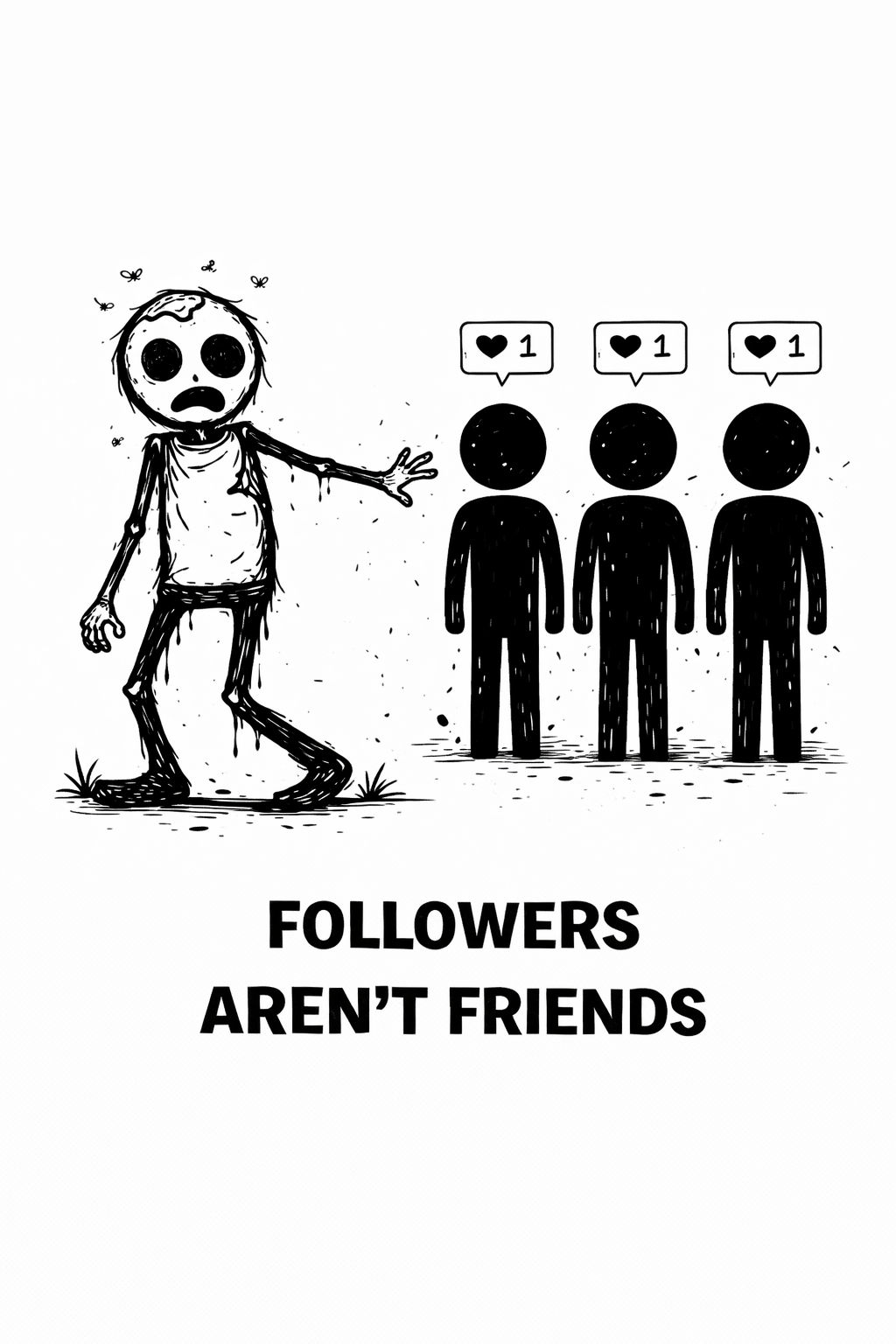
Followers Aren’t Friends
If you’ve been paying any attention for the last fifteen years, humanity quietly invented a new kind of relationship. You can now know someone without knowing them. You can watch their life unfold in real time. You can see what they eat, where they travel, what they think about politics, productivity, coffee, or the correct way to organize a refrigerator. You can watch their dog grow older and their house slowly fill with plants that appear suspiciously healthier than most human relationships; and you can do all of this without ever speaking to them. In the middle of this new friendship arrangement sits a number.
Followers.
It can look really impressive. Five thousand. Fifty thousand. Two million. The number carries weight because humans instinctively treat large numbers of people as social proof. If that many people are paying attention to someone, they must be important, when when they speak what they say must be worth listening to.
But followers aren’t friends, at least not in the way the word “follow” suggests.
What social media built is a form of audience membership, not companionship. The difference matters more than most people realize because the brain doesn’t always recognize the distinction immediately. The brain sees attention and assumes connection, but attention is not the same thing as relationship.
The Audience Illusion
Before the internet, audiences existed in specific places. A musician had an audience in a concert hall. A writer had readers who encountered their work through books or newspapers. A speaker had listeners sitting in rows of chairs.
The relationship was clear, one person was presenting something. Other people were observing it.
When the event ended, everyone went home, but social media collapsed that boundary. Now the audience follows you everywhere, appearing in your pocket. A post receives comments., then messages arrive, someone halfway across the world laughs at something you said while you are brushing your teeth and the audience begins to feel personal.
Creators often recognize this feeling first, they begin speaking directly to the people who follow them. The tone is conversational, sharing stories, opinions, and gradually the audience starts to feel less like a crowd and more like a collection of individuals creating a strange psychological shift. The creator feels known and the audience feels connected. But the relationship is still one-directional most of the time. A follower might know what you ate for breakfast and what you think about productivity, but they don’t know how you behave when you are tired, anxious, or having an argument about something trivial like where the car keys disappeared.
Those moments belong to real relationships. Followers experience the edited version. Social media lets you watch someone’s life for years without ever learning how they behave when the Wi-Fi stops working.
The Numbers Problem
The human brain struggles with scale. We evolved in small communities where relationships were limited by geography and time. Your social world consisted of the people you saw regularly, you learned their voices, their habits, their personalities. Friendship required proximity. Followers changed the scale entirely. Someone with one hundred thousand followers appears to have an enormous social network, feeling powerful because it implies influence. But influence isn’t intimacy. The majority of those people will never speak directly with the person they follow, they’re observers.
A person with a large audience can appear socially surrounded while still experiencing loneliness in their actual life. Meanwhile someone with a small group of close friends might have almost no online presence but enjoy deeper relationships. The numbers are measuring visibility, not measure connection. Ten thousand followers can still leave you without anyone to help you move a couch.
The problem is that humans instinctively treat large numbers as social validation. If thousands of people listen to you, your brain interprets that attention as belonging. But belonging requires mutual awareness, requiring people who know you well enough to notice when something is wrong.
The Performance Layer
Another reason followers can feel like friends is that social media encourages performance. People present themselves carefully. Only choosing specific photos for edited stories. Thoughts are shaped into posts that sound confident, thoughtful, or entertaining and the result is a version of life that looks coherent and intentional. Followers interact with only with that version.
Over time the performance becomes familiar. People begin to recognize your voice, your humor, your opinions. The interaction can feel conversational because comments appear and responses occasionally follow. But the interaction still exists within the boundaries of a stage. Real friendship happens backstage, when conversations wander without purpose. When silence is comfortable. When someone can admit confusion or insecurity without worrying about how it will look to an audience. Followers rarely experience those moments, they experience the curated version designed for public view.
It’s not dishonest, it’s simply the nature of broadcasting. When you communicate with thousands of people at once, the message becomes structured. Certain details disappear because they are too personal or too complicated to share widely, creating only a partial relationship.
Friendship operates through reciprocity. Through two people invest attention in each other and conversations move both directions. Each person understands the other’s life gradually through shared experiences. The relationship grows through time and interaction. whereas follower relationships function through one person speaking frequently while many others listen. Some respond with comments or messages, but the communication can’t become fully reciprocal when the scale grows large. A creator with thousands of followers can’t maintain thousands of friendships.
And so the structure becomes asymmetrical, the audience learns about the creator, but the creator learns very little about most of the audience. This imbalance doesn’t necessarily make the relationship meaningless. People genuinely enjoy the communities that form around shared interests online. Ideas travel, humor spreads, and encouragement appears from strangers who appreciate something you created.
But appreciation is not the same thing as friendship.
The Joshua Palms Perspective
The Joshua Palms way of looking at followers isn’t cynical. Followers are part of an audience that appreciate something you produce, whether it is writing, humor, ideas, photography, or commentary on how strange the world has become. That attention can be valuable. It allows ideas to travel and conversations to grow.
The internet created a powerful new form of connection where people who would never have met can now share ideas, stories, and encouragement across enormous distances. Communities form around creativity, curiosity, and humor. In many ways this is remarkable. They’re readers, viewers, listeners, and supporters. They’re an audience that chooses to pay attention to something you share. That attention is meaningful, but it does not replace the smaller circle of people who know your life in detail. Those people exist outside the metrics.vThey are the ones who notice when you are quiet. They are the ones who call without needing a reason. that understand your tone of voice well enough to know when something is wrong.
Followers press “like.” Friends show up with pizza when everything falls apart.