Living Long Isn’t the Goal.
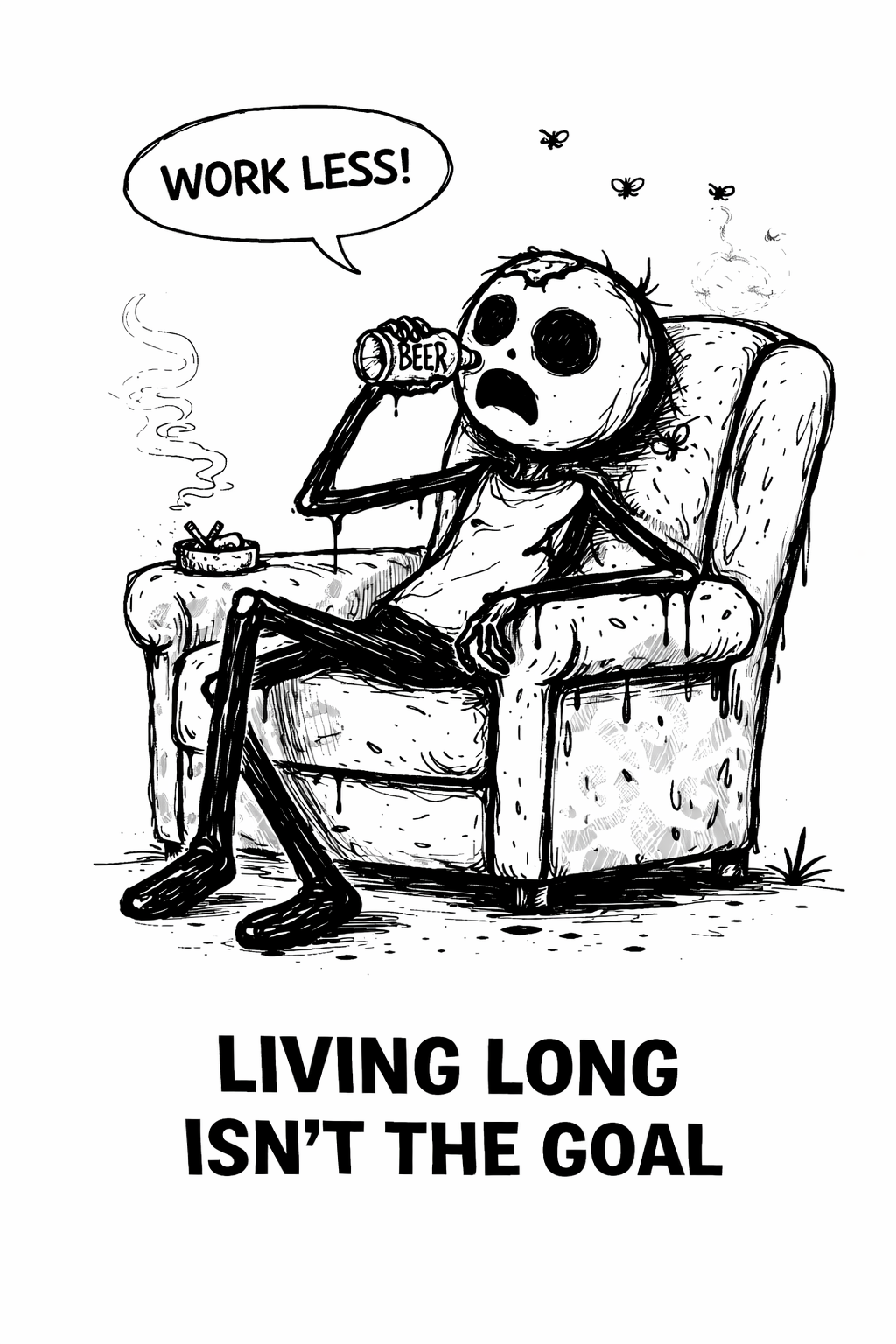
Someone quietly swapped the purpose of being alive without asking you. They didn’t announce it publicly, there wasn’t a press release, or a vote. One day the goal was living well, or living meaningfully, or at least living like you actually showed up for your own life. And the next day the goal became staying alive for as long as technologically possible, preferably while tracking it on a wrist device that congratulates you for standing up twice.
We didn’t choose it, we inherited it.
Longevity became the scoreboard because it’s the only part of existence that looks clean enough to quantify. Years. Decades. Age. Life expectancy curves. Blue zones. Anti-aging supplements. Sleep optimization. Cold plunges. Biohacking newsletters written by men who look like they’re afraid of bread. Entire industries orbit the idea that your job is to stretch yourself thinner and thinner across time, like a human taffy.
The uncomfortable thing nobody puts on a wellness poster is that a long life is not the same thing as a lived life. It’s just… longer.
There’s no cosmic rewards program where you hit eighty-seven and the universe slides you a little punch card and says, “Congrats. You won.” Time doesn’t care how carefully you managed it. Biology doesn’t hand out medals. The calendar is not a moral authority. We turned survival into virtue because it’s easier than asking what we’re surviving for.
The Age Number Is Not a Meaning Number
The most dangerous lie hiding in plain sight is that more time automatically equals more life. It doesn’t. It equals more time, that’s it.
You can stack years without stacking depth, you can accumulate decades without accumulating clarity, and you can protect your body with surgical precision while letting your actual days dissolve into soft beige routines that never challenge you, never rearrange you, never ask anything difficult of you. You can live very long and very small at the same time. That’s something most people don’t want to talk about, because it ruins the entire narrative. The modern fantasy is that if you just manage your inputs correctly, life will quietly become satisfying on its own. Eat this. Avoid that. Track this. Optimize that. Delay death long enough and fulfillment will magically wander in like a lost Amazon package.
But meaning does not arrive by postponement, it arrives by collision or risk or emotional exposure. By trying things that are not guaranteed to work, relationships that might implode, creative projects that might humiliate you, decisions that don’t come with statistical reassurance, or seasons of your life that look inefficient on a spreadsheet. A safe life can is more likely to be hollow just as a careful life is more likely to be empty. A perfectly optimized life can still feel like you never actually stepped into it. We treat aging like a video game boss fight we’re supposed to defeat. Wrinkles are framed as a moral failure, slowing down is framed as weakness., and death is framed as a glitch in the product instead of the only honest boundary the system has ever had. So everything becomes about delay.
Delay pain.
Delay loss.
Delay uncertainty.
Delay the moment when you have to admit you don’t know what you’re doing.
When you build a life around delay, you accidentally delay living itself, the tragedy isn’t dying too early; It’s dying after spending most of your time preparing to start. There’s a reason so many people reach their forties and fifties and suddenly feel panicked without understanding why. They were promised that if they played correctly, meaning would unlock later. After the grind, the kids grow up, the promotion. After the debt is gone, the house is finished, the body is fixed…After the chaos calms down. Later isn’t a place, its a story you tell yourself so you don’t have to confront how narrow your present has become. Longevity culture loves to talk about the future version of you. Healthier, calmer, wiser, emotionally regulated. They’re always just far enough away to justify postponing everything risky and interesting today.
You don’t live as yourself, you live as a prototype. And prototypes don’t get messy… They wait.
You Aren’t a Battery You’re Supposed to Keep Full
Somehow we started talking about human energy like it exists only to be conserved. Don’t burn out. Don’t overextend. Don’t push too hard. Don’t destabilize your life. Don’t take emotional risks. Don’t make big changes too fast. Don’t quit unless you have something lined up. Don’t start unless you know how it ends. Be careful, because it sounds responsible; but it also sounds suffocating.
You aren’t a battery designed to be kept between twenty and eighty percent charge for optimal lifespan. You’re a nervous system designed to respond to meaning, and meaning isn’t efficient. It’s disruptive. It rearranges priorities, makes you tolerate discomfort you would otherwise avoid, makes you temporarily worse at some things while you become better at others, breaks identities that were built to keep you socially acceptable rather than internally honest.
Living long became the goal because it allows you to avoid the scarier question: What would make this life worth spending?
That question is destabilizing and has no universal answer. It can’t be outsourced to experts. It doesn’t fit into an app. It forces you to confront how much of your time is shaped by inertia rather than intention.
Joshua Palms exists inside that discomfort.
Not to tell you to self-destruct. Not to romanticize chaos. Not to shame people who care about their health, but to point at the quiet trade-off nobody names: You can make your life safer, or larger, but you can’t have it both ways. There’s no lifestyle that protects you from uncertainty and also delivers a deeply personal, meaningful existence without risk. Those two desires pull in opposite directions more often than wellness culture is willing to admit. And the reason that might hurt to hear is because many of us already built our lives around safety. Around predictability. Around respectable trajectories. Around social proof. Around not rocking boats we worked very hard to climb into. We tell ourselves we’ll live later.
Once we’re more secure.
Once we’re more prepared.
Once we’re more optimized.
However, later isn’t guaranteed. And worse than that, Later is not automatically braver. Most people don’t become more courageous with time, they become more invested in what they would have to risk. That’s why living long is such a seductive goal.
Someone taught you to treat your lifespan like a project to manage. Joshua Palms is here to remind you that your life isn’t a storage problem. Its a meaning problem. You don’t solve it by extending the container, you solve it by finally deciding what you want to put inside it.