Wrong isn’t real.
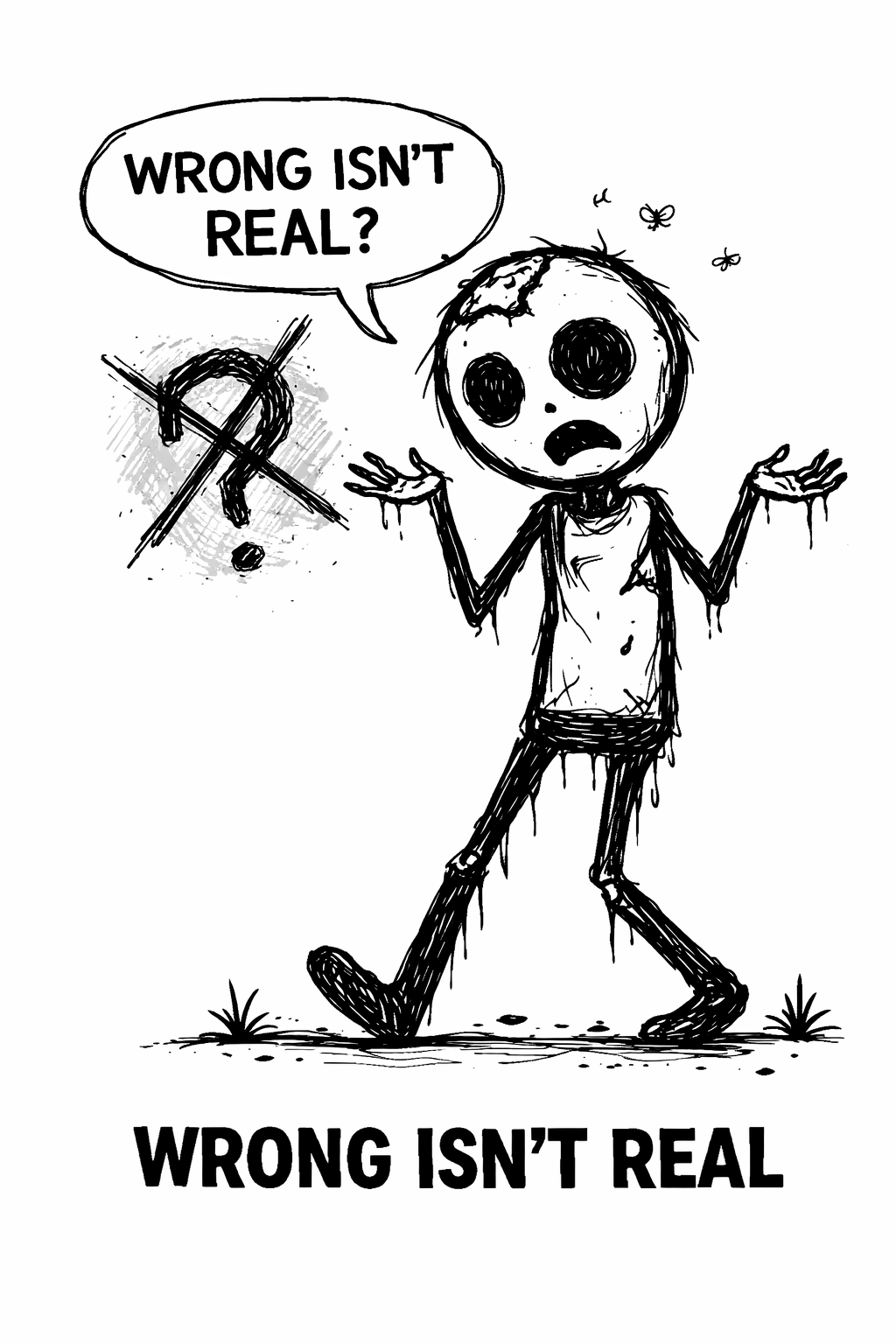
Wrong Isn’t Real
At some point in your life, probably earlier than you remember, someone handed you a tiny invisible hammer and said, “This is how you tell when something is wrong.” And you nodded, because you were small and the person was large and they sounded confident, and confidence feels like truth when you’re still figuring out where your hands end. Since then, you’ve been tapping that hammer against everything. Careers. Relationships. Clothes. Thoughts. Desires. Entire versions of yourself. Wrong. Wrong. Wrong. The hammer never breaks. You do.
Here’s the part nobody tells you: “Wrong” isn’t a property of the universe. It’s not gravity. It’s not oxygen. You can’t dig it up. You can’t measure it. You can’t find it under a microscope. “Wrong” is a social sound effect, its a buzzer, its a red X flashed by someone who got there earlier and would like you to stay in line. The world runs on this noise. Schools hum with it. Offices echo with it. Families pass it down like an heirloom watch that only tells one time. You’re wrong for wanting that. Wrong for not wanting this. Wrong for asking. Wrong for waiting too long. Wrong for moving too fast. Wrong for leaving. Wrong for staying. It’s a miracle anyone does anything at all.
Yet somehow you already know it doesn’t fully add up. You feel it every time two people argue and both are certain. Every time history flips and yesterday’s sin becomes tomorrow’s TED Talk. Every time you apologize for something that didn’t actually harm anyone but made a room slightly uncomfortable. If “wrong” were real, it would behave better than this. It wouldn’t shapeshift based on who’s holding the microphone.
The Invention of the Buzzer
“Wrong” didn’t fall from the sky. It was built as a shortcut, as crowd control. As a way to end conversations without finishing them. When someone says “That’s wrong,” what they usually mean is “That doesn’t fit the system I rely on to feel safe.” But that sentence takes longer, and it makes things awkward, so we went with the buzzer. The buzzer works fast. It’s emotional. It doesn’t require evidence, just tone. That’s why it scales so well. You can run entire institutions on it. Religion figured this out early. So did governments. So did corporations with employee handbooks thicker than most sacred texts. “Wrong” is cheaper than explanation. Cheaper than nuance. Cheaper than admitting uncertainty.
Look closely and you’ll see that “wrong” almost always protects something fragile. A hierarchy. A tradition. A revenue stream. A worldview that collapses if too many people ask why. Calling something wrong doesn’t just reject the behavior, it freezes the debate. It signals that discussion is over and punishment is now appropriate. The buzzer doesn’t want understanding. It wants compliance.
This is why “wrong” ages so poorly. Things don’t stop being wrong because humans became more moral; they stop being wrong because the systems that needed them to be wrong lost power. Interracial marriage. Women working. Not hating yourself for existing. These weren’t discovered as acceptable, they were reclassified. They are the same behaviors with new labels coming from the same species pretending it just unlocked ethics.
If “wrong” were real, it wouldn’t need this many updates.
Confusing Harm With Discomfort (On Purpose)
Now, let’s address this before someone fires up the comments section like a leaf blower: Harm is real. Pain is real. Consequences are real. But “wrong” is a lazy wrapper we slap on top of all of it so we don’t have to do the harder work of distinguishing between damage and discomfort. Discomfort gets called wrong constantly. Not because it hurts anyone, but because it rattles current expectations. A career path that zigzags. A relationship that doesn’t escalate on schedule. A person who doesn’t want what they’re “supposed” to want. None of these things break bones or steal resources, they break scripts. And scripts are sacred to people who confuse predictability with safety.
We punish deviation by moralizing it. We don’t say, “This makes me uneasy because it challenges the story I tell myself about how life should work.” We say, “This is wrong.” Its Cleaner, easier to digest. Much more likely to shut the other person up before they accidentally reveal that there are multiple ways to be alive. That’s why people feel wrong even when nothing bad happened. You can be fed, employed, loved, and still feel like you’re failing some invisible test. That test is imaginary. It changes per household, per city, per decade. But the anxiety is real, because the threat of being labeled “wrong” carries social consequences: rejection, ridicule, exile from the warm glow of approval.
And approval, for better or worse, is one hell of a drug.
Life Without the Buzzer
Imagine, just for a second, removing the word “wrong” from your internal vocabulary. Not consequences. Not ethics. Just the buzzer. What happens?
Things get quieter. Scarier. Slower. You’re forced to ask better questions. Does this cause harm? To whom? For how long? Is this aligned with what I value, or just what I was trained to repeat? Am I reacting, or choosing? Without “wrong” to lean on, you have to actually think. Which is why so many systems work overtime to keep the buzzer plugged in.
That doesn’t make life easier, it makes it more honest. You lose the comfort of moral shortcuts, but you gain something rarer: agency. You stop outsourcing your compass to whatever authority sounds the angriest. You realize that most of your fear wasn’t about doing harm, it was about being seen, judged, categorized, and filed under Incorrect Human. Here’s the quiet truth hiding under all of this: most people aren’t afraid of being wrong. They’re afraid of being alone. “Wrong” is just the word we use to justify who gets included and who doesn’t. Once you see that, the spell weakens. Not instantly. But enough to breathe.
Joshua Palms isn’t here to tell you nothing matters. That’s lazy nihilism and it smells like a dorm room. This is about something more uncomfortable and more freeing: you have to decide what matters, and you don’t get a buzzer to hide behind. You don’t get to call your fear “morality” anymore. You don’t get to confuse tradition with truth just because it came pre-installed.
“Wrong” isn’t real, but Responsibility, Choice, and Impact are. Meaning is something you build, not something you inherit fully formed from whoever yelled the loudest when you were young. The next time that buzzer goes off in your head, when you feel that familiar clench, that instinct to self-correct, self-censor, self-erode…pause. Ask who installed it and who benefits when it rings. Ask whether you’re actually about to cause harm, or just about to surprise someone who likes the world predictable. Then decide anyway.
Because if everything meaningful you’ve ever done came with a little fear attached… maybe that fear wasn’t a warning, maybe it was just the sound of an imaginary system losing its grip.