Confidence Isn’t Real.
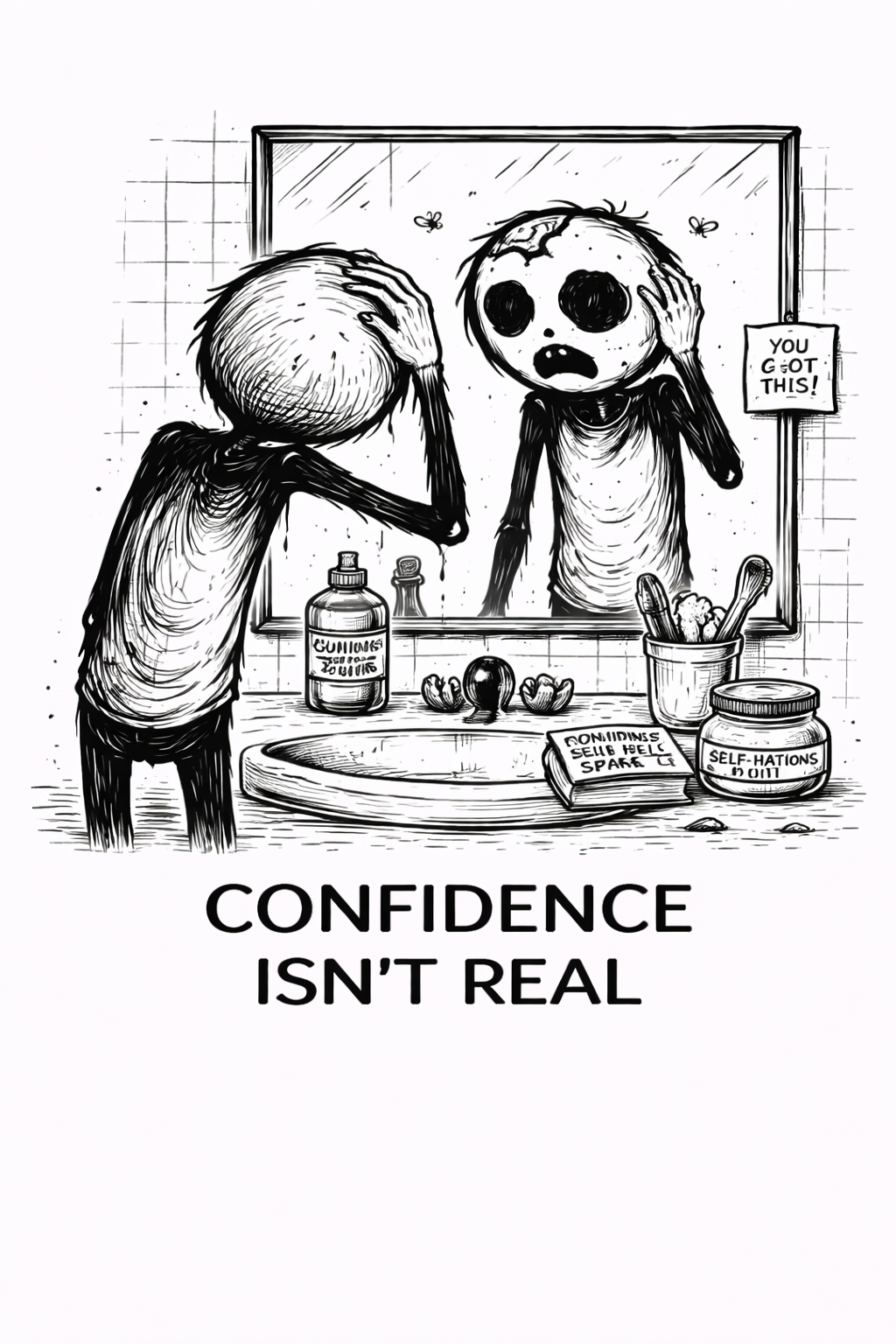
Confidence is a magic trick. It doesn’t come from truth. It doesn’t come from correctness. It doesn’t come from competence nearly as often as we’d like to believe. Confidence comes from the absence of visible doubt. And we mistake that absence for authority. That’s the scam.
Confidence Is a Performance, Not a Measurement
People talk about confidence like it’s a substance. Like some people just have it, stored somewhere between the ribs and the soul, while others tragically missed out. That’s comforting. It means we don’t have to interrogate it. But confidence is not a trait. It’s a behavior. Psychologist Albert Bandura defined self-efficacy (often confused with confidence) as belief in one’s ability to execute actions, not belief in correctness.
Translation: Confidence doesn’t mean you’re right. It means you believe you can act. That’s it. And belief is cheap.
Your Brain Mistakes Calm for Competence
Here’s the neurological problem: The human brain is lazy. When assessing others, it looks for shortcuts:
Tone of voice
Speed of speech
Posture
Eye contact
Absence of hesitation
Neuroscientists call this thin-slicing, rapid judgments made with minimal data. So when someone speaks smoothly and doesn’t flinch, the brain goes: “Ah. Leader. Knows things.” Even if they’re saying nonsense. Especially if they’re saying nonsense smoothly, confidence hijacks perception before logic ever shows up.
Confidence Is Mostly Adrenaline
Physiologically, confidence isn’t some noble mental state. It’s arousal. Increased heart rate. Increased dopamine. Lowered inhibition. The same chemicals involved in:
Risk-taking
Gambling
Aggression
Public speaking
Bad first dates
Neuroscientist Antonio Damasio showed that emotion and bodily states precede rational decision-making. Meaning: You feel confident before you think confident. The body goes first. The brain just writes the press release. There’s a famous cognitive bias called the confidence heuristic. We assume confident people are more accurate, even when they’re not.
Psychologists Koriat, Lichtenstein, and Fischhoff demonstrated that confidence and correctness are often weakly correlated. Translation: People who are wrong are often just as confident as people who are right. Sometimes more. Because doubt requires reflection. Reflection requires effort. Effort looks like hesitation. Hesitation loses elections, arguments, and meetings.
The Dunning-Kruger Problem Nobody Likes to Admit
Let’s talk about the elephant in the room wearing a blazer. The Dunning-Kruger effect shows that people with low ability often overestimate their competence, while highly skilled people underestimate theirs. Why?
Because knowing a lot exposes you to how much you don’t know. Ignorance is confident. Knowledge is cautious. This is why:
Experts hedge
Beginners declare
Charlatans sell courses
Confidence isn’t proof of understanding. It’s often proof of blind spots. Confidence exists to solve a social problem, not an epistemic one. It answers the question: “Who should we listen to right now?” Not: “Who is correct?” Sociologist Erving Goffman described social life as impression management. Confidence is one of the most effective impressions. It says:
“Follow me.”
“I’ll decide.”
“I won’t panic.”
None of those require accuracy. They require certainty theater. Here’s the uncomfortable truth: Most confidence is fake. And that’s not always bad. Psychologist Amy Cuddy popularized research showing that posture and behavior can alter internal states. People don’t act confident because they feel confident. They feel confident because they act confident. Confidence is often rehearsed. Practiced. Borrowed. Everyone is winging it. Some people just stopped apologizing for it.
Confidence Culture Is Addictive
Modern culture worships confidence, rewarding:
Certainty over nuance
Speed over thoughtfulness
Assertion over curiosity
Social media amplifies this by design., favoring:
Declarative statements
Hot takes
Absolutes
No hesitation
Nuance doesn’t go viral like confidence does. That’s how loud opinions replace informed ones. Philosopher Bertrand Russell nailed this centuries ago: “The whole problem with the world is that fools and fanatics are always so certain of themselves, and wiser people so full of doubts.” Confidence isn’t wisdom’s ally. It’s often its enemy. Wisdom hesitates while confidence charges ahead. One builds understanding. The other builds followings.
The Dark Side: Confidence Silences Better Voices
People who Think carefully, speak slowly, ask questions, or admit uncertainty are routinely overlooked. Meanwhile, the confident get promoted. Psychologist Adam Grant has written extensively about how organizations confuse confidence with competence, often at great cost. This is how bad ideas survive meetings. This is how disasters get approved. This is how everyone wonders later, “How did no one stop this?” They did. They just weren’t confident enough.
Real confidence isn’t fearlessness. It’s tolerance for fear. The body feels fear. The person acts anyway. That distinction matters. Because most “confident” people are terrified. They’ve just learned not to show it. Confidence isn’t courage. It’s fear management.
Self-help loves confidence because it’s easy to sell. “Just believe in yourself.” “Fake it till you make it.” “Manifest certainty.” None of this addresses: Accuracy, Skill, Knowledge, or Ethics. Confidence is marketed as a shortcut to success because shortcuts sell. But confidence without calibration is dangerous. It builds bridges without checking weight limits.
What Actually Matters More Than Confidence
If confidence isn’t real, what is?
Curiosity — the willingness to ask
Humility — the ability to revise
Competence — earned, not declared
Presence — paying attention
Integrity — acting despite uncertainty
These don’t look impressive in a meeting. They don’t sound strong on a podcast. But they quietly outperform confidence over time. You don’t need to look sure. You need to be honest because honesty scales better than bravado. Confidence is just what happens when fear learns to stand up straight and speak clearly.
It’s useful. It’s persuasive. It’s often wrong.
Treat it accordingly.