Zombies are already here.
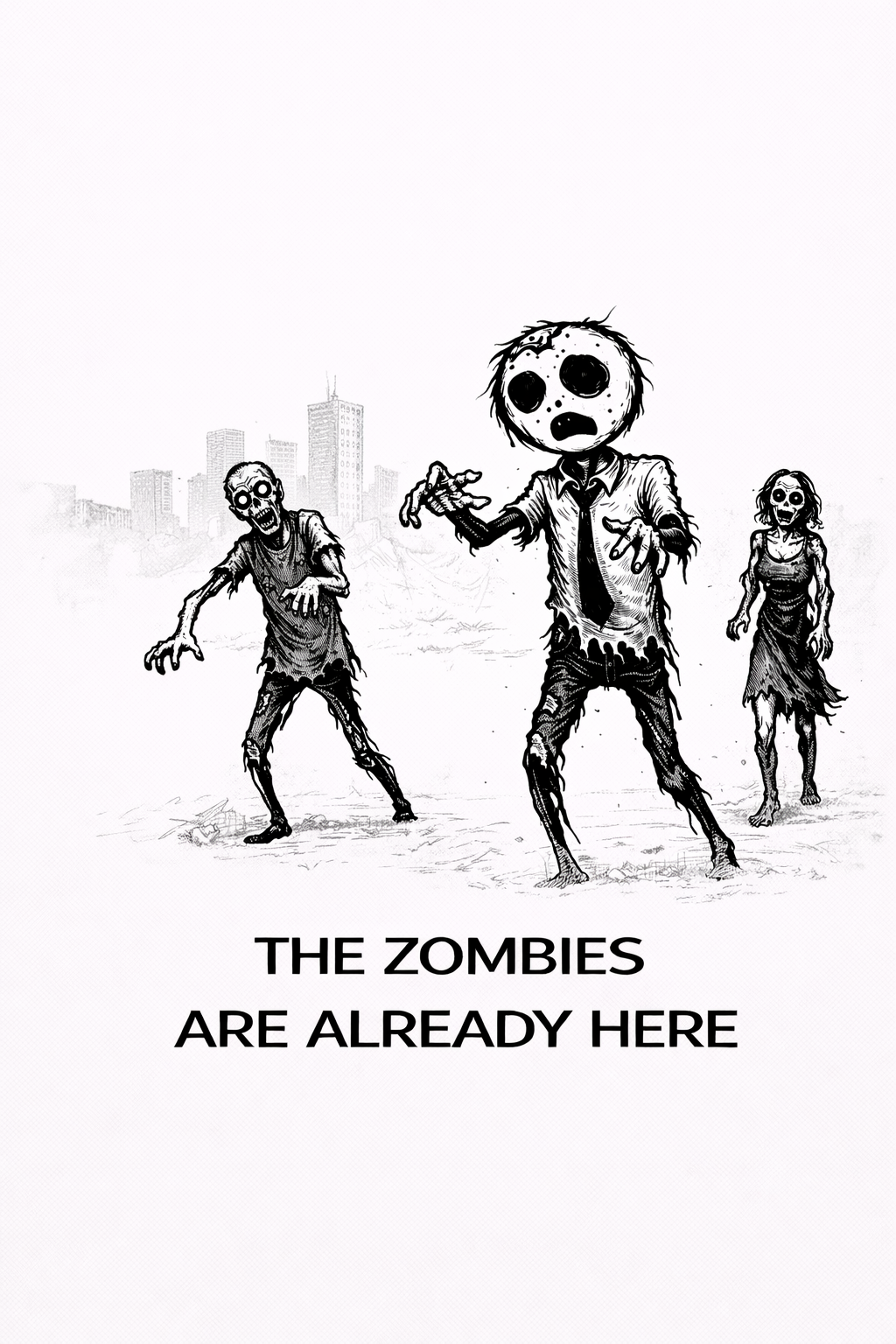
The Zombie Apocalypse Is Already Happening
Everyone keeps waiting for the zombie apocalypse like it’s going to arrive with smoke machines and sirens. Like one morning you’ll wake up and there will be a guy in your driveway chewing on a mailbox and CNN will finally be useful again. But that’s not how this works. That’s never how this works. Apocalypses (apocalypsi?) don’t announce themselves. They roll out quietly, they ship in beta, they show up disguised as convenience. The zombie apocalypse didn’t start with a bite. It started with a notification. No blood. No screaming. Just a soft vibration in your pocket. A little red circle. A number. A promise. You didn’t lose your humanity all at once. You handed it over one scroll at a time, like spare change. Nobody forced you. That’s the elegant part. You volunteered.
Zombies aren’t monsters. Zombies are people who stopped choosing. People who move, consume, repeat, and react without reflection. People who are technically alive but no longer steering. That’s not an insult—it’s a diagnosis. And if you’re feeling defensive right now, congratulations: the infection is working. This is the apocalypse where everyone still goes to work. Where nobody screams because nobody notices. Where the streets aren’t empty, they’re just filled with bodies walking while their minds are elsewhere. Heads down. Thumbs twitching. Eyes glazed over like a Krispy Kreme conveyor belt of consciousness.
You don’t need to die to become a zombie. You just need to stop paying attention.
The Infection Was Free
Every good zombie story has a patient zero. In this one, patient zero was a guy saying, “It’s just a way to stay connected.” Social media didn’t show up wearing a lab coat and evil laugh. It showed up wearing friendship, creativity, opportunity. It promised that it would amplify your voice, not replace it. It promised deeper connection, not control. And technically, it delivered. Just not in the way you think. Connection became performance then expression became optimization. Thought became content. Identity became a brand you are required to manage seven days a week or risk fading from relevance like an expired yogurt. The feed didn’t just show you the world, it trained you how to be in it.
At first, it felt optional. Then it felt important. Then it felt mandatory. That’s the curve. That’s always the curve.
The infection doesn’t rot your flesh. It rots your attention. It teaches your brain to crave novelty over meaning, reaction over reflection, validation over truth. It rewards sameness and punishes deviation. Not overtly, but subtly. With silence. With fewer likes. With invisibility. Zombies don’t need chains when they’re afraid of being unseen. Scroll long enough and you’ll notice something unsettling: everyone starts to sound the same. They use the same phrases, tell the same jokes, and exhibit the same outrage cycles with different fonts. The platform doesn’t tell you what to think, it narrows the range of acceptable thoughts until you choose the same ones voluntarily. That’s not censorship, its worse, that’s conditioning. And the scariest part? It feels like freedom the whole time. You can post whatever you want. As long as it fits the format and it performs and it doesn’t disrupt the dopamine economy.
Zombies don’t feel trapped. They feel busy.
The Walking Feed
Look around in public. Not metaphorically, literally. At coffee shops, airports. parks, restaurants, couples on dates scrolling in parallel silence like two corpses politely ignoring each other. Parents recording children instead of watching them. Friends documenting moments they’re not actually experiencing. Everyone is there, but nobody is here.
Eyes open. Minds elsewhere. That’s classic zombie behavior.
The feed trains you to live in fragments. Ten, fifteen seconds. Thirty if you’re feeling ambitious. Long enough to react but not long enough to understand. Nuance starves in that environment. Complexity dies first. Zombies don’t ask follow-up questions. Zombies share headlines. You can feel it happening inside yourself. The itch to check. The reflex to reach for your phone during the slightest lull, like silence itself has become unbearable. That’s not boredom, that’s withdrawal. Your brain has been taught that stillness is a threat; if nothing is happening, something must be wrong. So you fill every gap with noise. Opinions you didn’t ask for, outrage you didn’t earn, or desire you didn’t choose. You become a conduit instead of a consciousness, letting thoughts pass through you, not from you.
And the algorithm loves that version of you. Predictable. Reactive. Divisible into data points. Zombies are easy to monetize.
Remembering You’re Not Dead Yet
Here’s the part zombie movies never show you enough of: the moment before. The moment when the infected person feels something is off but can’t quite name it. The low-grade dread, that sense of time slipping faster. That feeling that you’re consuming more than you’re creating, reacting more than you’re deciding, scrolling more than you’re living. It’s not nostalgia, it’s your nervous system waving a tiny white flag. The goal isn’t to smash your phone with a rock and run into the woods screaming about frequency. The goal is to reclaim agency in a system designed to erode it. Zombies don’t need to be destroyed. They just need to wake up. Pay attention to how often you repeat things you haven’t examined. How often you borrow outrage instead of forming opinions. How often you confuse being informed with being flooded. The infection thrives on speed so awareness slows it down.
Joshua Palms isn’t anti-technology. It’s anti-sleepwalking. Anti-default. Anti-living your one weird, fragile life as an NPC in someone else’s engagement funnel. You weren’t put here to be optimized. You weren’t born to perform for metrics invented by people who will never know your name.
The zombie apocalypse isn’t coming. It’s here.
And the twist, the part that still matters, is that you can feel it happening. Zombies in movies don’t get that luxury. You do. Which means this isn’t a horror story yet. It’s a decision point. Put the phone down sometimes. Sit with a thought long enough for it to become yours. Let boredom stretch until it turns into curiosity instead of panic. Remember what uninterrupted attention feels like. That’s not rebellion. That’s resuscitation.
Because the most dangerous thing about this apocalypse isn’t that it kills people. It’s that it convinces them they’re still fully alive while slowly teaching them how not to be.