New Year’s isn’t real.
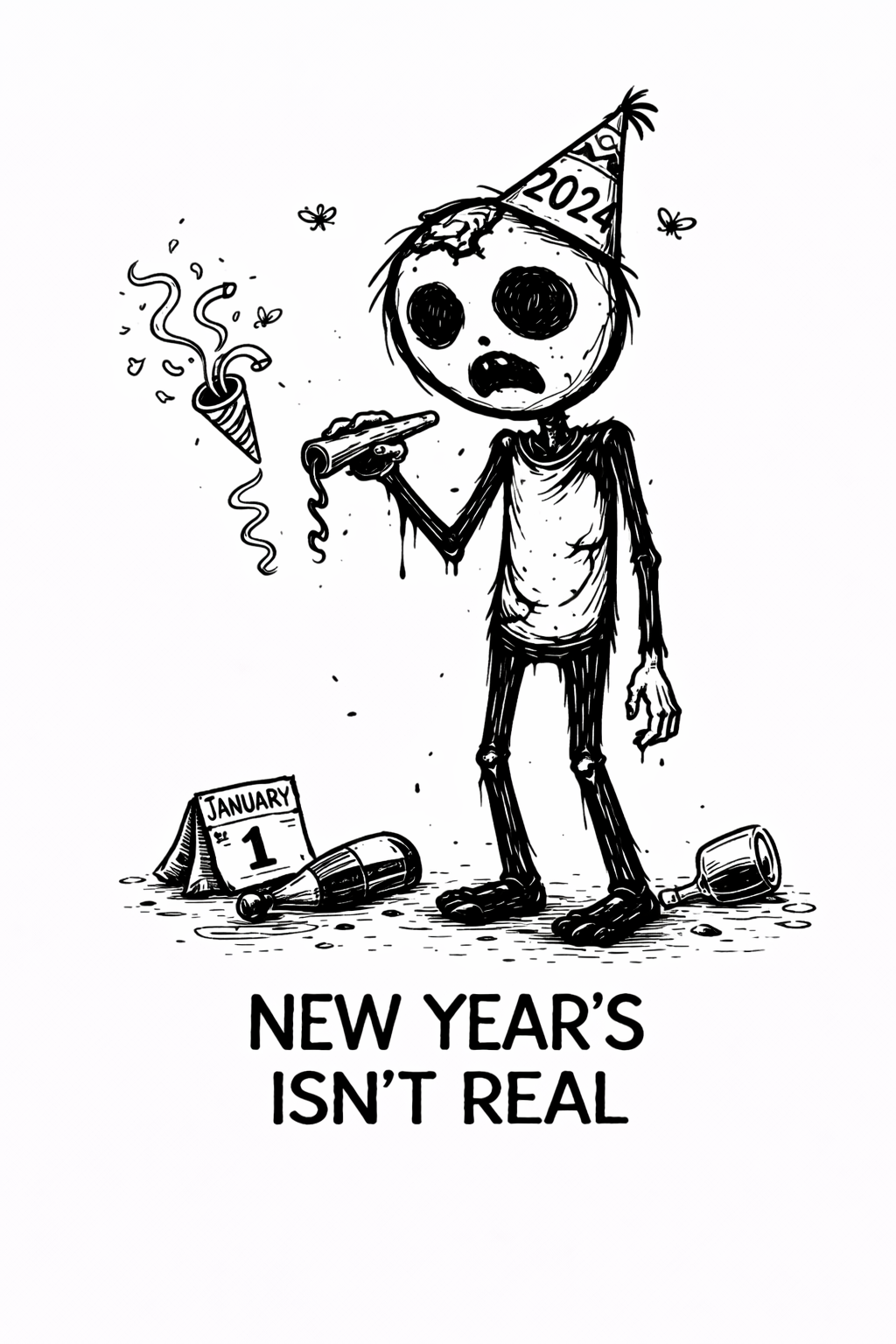
At exactly 11:59 p.m., the room fills with countdown energy. Someone starts shouting numbers like they’re defusing a bomb. Strangers hug. Couples kiss out of obligation. A man who hasn’t exercised since 2017 promises a gym he will never visit that this time is different. Then the clock flips, confetti falls, and, miracle of miracles, the same problems walk into January wearing a cheap plastic hat.
Happy New Year. An event that does not exist.
That’s not cynicism. That’s history.
The “New Year” is not a law of physics. It does not occur in nature. Trees don’t drop leaves on December 31st because the calendar told them to. The sun doesn’t blink at midnight. No animal resets its personality because an arbitrary number increments. New Year’s is a story, agreed upon, rehearsed, ritualized, and enforced by social pressure and champagne.
Which doesn’t mean it’s useless. It just means it’s made up. And like most made-up things, it’s powerful, absurd, comforting, and occasionally dangerous.
Someone Picked a Day and We Never Questioned It
The idea of a “new year” only works if time itself has been chopped into pieces. Humans are very good at chopping things up. We sliced the planet into borders, the day into minutes, and life into milestones like “before 30” and “after it’s too late.”
Ancient civilizations didn’t agree on when the year started. Some tied it to harvests. Others to floods. The Romans famously kept changing it depending on who was in charge and what was convenient politically. In fact, January wasn’t even the start of the Roman year until 153 BCE, when it became administratively useful. Bureaucracy, not destiny, crowned January.
Later, Pope Gregory XIII adjusted the calendar again in 1582 to fix astronomical drift, giving us the Gregorian calendar most of the world uses today. When people protested losing days overnight, the state shrugged. Time had been edited. Life went on.
So when you toast to “a fresh start,” you’re not honoring nature. You’re honoring a committee decision refined over centuries.
Sociologist Peter L. Berger would call this a textbook example of social construction: an idea invented by humans that hardens into reality because everyone agrees to treat it that way. Once enough people believe it, it becomes real enough to govern behavior, emotions, and expectations.
The New Year isn’t real, but belief makes it operational.
Psychologists have identified something called the “fresh start effect,” popularized by behavioral economist Katy Milkman. The idea is simple: temporal landmarks, like Mondays, birthdays, or January 1st, help people mentally separate their “old self” from a “new self.” In theory, this is useful. It allows people to say, That version of me belongs to before. This version starts now. In practice, it’s messier.
The brain doesn’t actually reset at midnight. Habits don’t dissolve because fireworks went off. You don’t wake up with a new personality because the calendar says so. What you wake up with is a hangover and the same neurological wiring you had on December 30th. But belief does something subtle. It creates permission.
Permission to try again.
Permission to forgive failure.
Permission to imagine change without evidence yet.
That’s the pro. The con is that when January fails to deliver transformation, the blame rarely goes to the myth. It goes to you.
The Hope Scam
New Year’s resolutions are fascinating because they fail in predictable, almost comforting ways. Gyms fill up for six weeks. Productivity apps spike in downloads. Journals are purchased, written in twice, then abandoned in a drawer like a bad relationship.
This isn’t because people are weak. It’s because the system is dishonest. We treat January 1st like a cosmic green light. We load it with unrealistic expectations. We demand personal reinvention without structural change. Same job. Same stress. Same environment. Different number. Philosopher Friedrich Nietzsche warned about this kind of false hope, the danger of postponing life until some imagined future moment when conditions will finally be right. The New Year becomes a holding pattern. A delay tactic. A way to survive December by promising January will save us.
But January doesn’t save anyone. It just shows up.
One of the darker truths about New Year’s is how much pressure it puts on reflection. Suddenly, you’re expected to evaluate an entire year like a quarterly performance review.
Did I grow?
Did I succeed?
Was this a good year?
Compared to what?
Based on whose metrics?
Historian Yuval Noah Harari points out that humans live inside shared myths, stories about money, nations, success, and progress that only exist because we collectively believe in them. The New Year functions as a progress checkpoint inside that myth system. If you didn’t advance, optimize, or glow up, the calendar quietly suggests you wasted something. But time is not a resource that can be wasted the way social media wants you to believe. It passes whether you monetize it or not. The sun does not care about your personal brand. The idea that you must extract value from every year is a modern anxiety dressed up as tradition.
The Pros of Believing in New Year’s (Yes, There Are Some)
Let’s be fair. Myths persist because they serve functions.
1. Collective Pause
New Year’s creates a rare moment when a large portion of society stops at the same time. Work slows. Messages soften. There’s space to breathe. Even if the reason is fake, the pause is real.
2. Shared Ritual
Rituals matter. Anthropologists have long shown that shared ceremonies strengthen social bonds. Singing the same song, counting down together, or clinking glasses with strangers reminds people they’re not alone in the mess.
3. Narrative Reset
Stories need chapters. The New Year provides one, even if it’s arbitrary. For some people, that’s enough to interrupt despair and try again. That’s not nothing.
Psychologist Viktor Frankl argued that humans can endure almost anything if they find meaning. New Year’s is meaning on layaway. Sometimes that’s enough to get through the night.
The Cons (Where It Gets Ugly)
1. False Urgency
Believing change must start on January 1st discourages change on January 3rd, March 14th, or a random Tuesday when you actually feel ready. The calendar becomes a gatekeeper.
2. Shame Cycles
When resolutions fail, people don’t question the ritual. They internalize the failure. The myth stays intact. Self-worth takes the hit.
3. Commercial Hijacking
Modern New Year’s is less about reflection and more about optimization. Buy the planner. Download the app. Fix your body. Fix your mindset. Fix everything, immediately.
Sociologist Zygmunt Bauman described this as “liquid modernity”: a world where identities are endlessly flexible, but stability is scarce. The New Year feeds this anxiety by suggesting you are always one reset away from adequacy.
The Quiet Truth Nobody Toasts To
Nothing actually starts over. You carry yesterday into today, whether the date changes or not. Grief doesn’t reset. Love doesn’t reset. Burnout doesn’t reset. Healing doesn’t reset.
And that’s not a failure. That’s continuity. The obsession with fresh starts can distract from something more honest: ongoing adjustment. Life doesn’t reboot. It recalibrates. Slowly. Unevenly. Without fireworks.
Philosopher Albert Camus argued that meaning isn’t found in grand resolutions but in daily rebellion against absurdity, choosing to continue despite knowing there’s no ultimate reset button.
Which means the most radical thing you can do on January 1st is… nothing special.
You don’t need a new year to stop lying to yourself.
You don’t need fireworks to leave something that’s harming you.
You don’t need a countdown to begin again.
The calendar didn’t trap you, and it can’t free you either. New Year’s is a prop, a socially approved moment to look at your life and ask uncomfortable questions. Use it if it helps. Ignore it if it hurts. Just don’t confuse the ritual with reality. Because the most honest truth about January 1st is this:
Nothing magical happened at midnight. But you’re still here. And that’s already enough to keep going.