Trust isn’t what you Think.
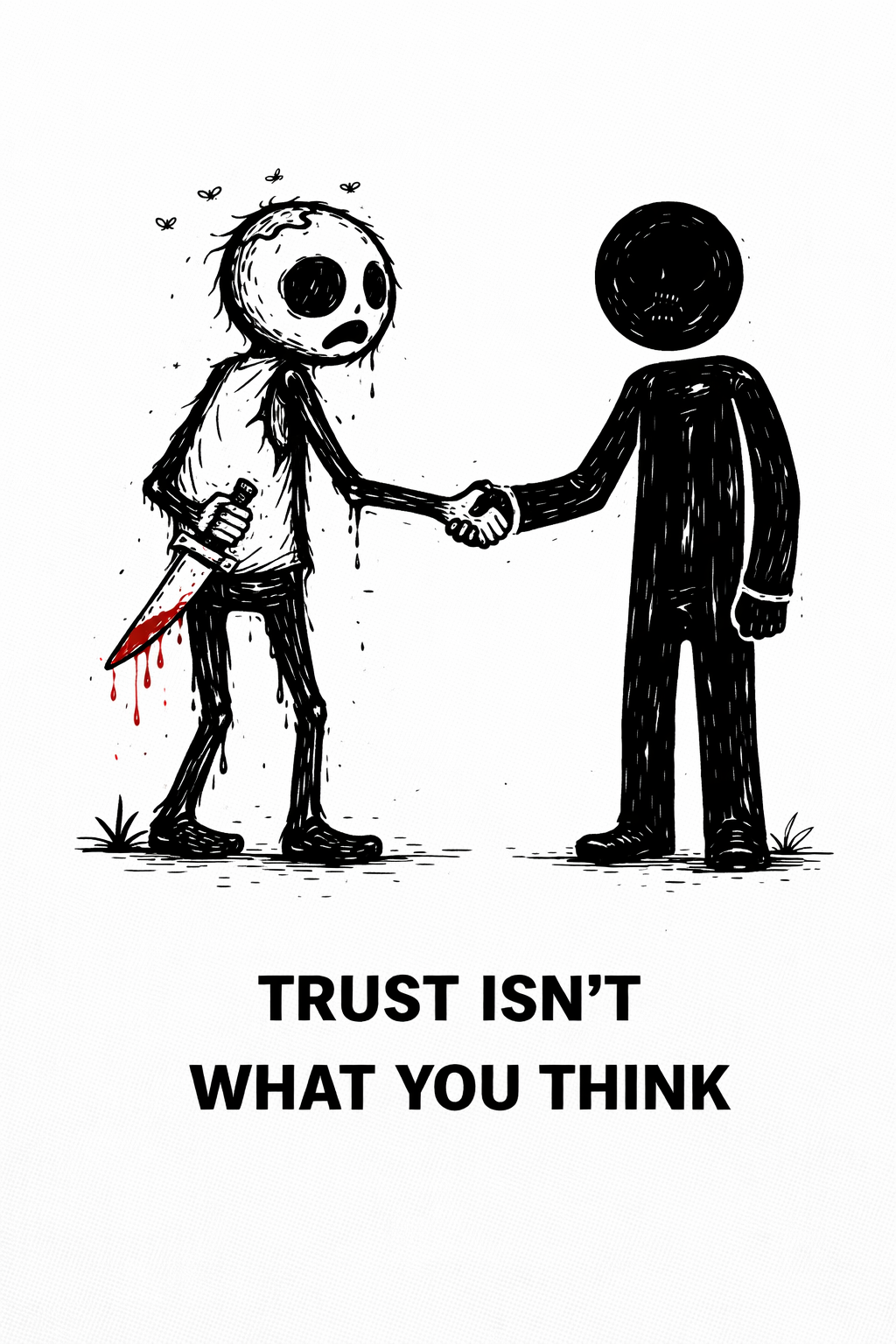
Trust Isn’t What You Think
Trust is talked about like it’s a fragile glass sculpture sitting in the middle of a room. Once it breaks, they say, it can never be repaired and once it’s gone, it’s gone forever. Entire speeches are built around this idea. Leaders give it dramatic weight, relationships are evaluated by it, and businesses write it into mission statements with the same solemn tone normally reserved for national anthems.
Trust, we’re told, is everything. but trust isn’t what you think.
Trust isn’t a permanent state. It’s not a moral certification someone earns once and carries around like a laminated badge or a sacred contract that guarantees future behavior. If it were, the world would look very different. People would never disappoint you twice, institutions would never collapse under the weight of their own contradictions, and the phrase “I can’t believe they did that” would disappear from the language.
Instead, trust behaves more like a prediction. Every time you trust someone, what you’re really doing is running a quiet probability calculation inside your brain, estimating how likely it is that this person will behave in a certain way based on everything you’ve seen so far. Taking into consideration their past behavior, incentives, personality, the environment they’re operating in, and the tone in their voice when they said the thing they said. Your brain runs the model without telling you, produces a probability, and then your emotions translate that probability into a feeling. That feeling is what we call trust.
This is unsettling, because it means trust isn’t certainty. It’s just confidence in a forecast, and forecasts change.
The Comfort of Certainty
Humans desperately want trust to be permanent because permanence is comforting. If trust could be locked in place like a safe combination, relationships would feel stable, friendships would feel secure, institutions would feel dependable, and we could move through the world with the quiet confidence that once someone proved themselves trustworthy, the matter was settled.
But that’s not how humans work.
People change and incentives change. A person who behaves one way in calm conditions might behave very differently when pressure arrives. Someone who seems generous when resources are abundant might behave cautiously when those resources become scarce. The same person can be loyal in one context and unreliable in another. Trust collapses when we forget that context exists. We tend to evaluate trust like a personality trait. “They’re trustworthy.” “They’re not trustworthy.” The language suggests something fixed and universal, like height or eye color. But trust is situational, it depends on what the person stands to gain, what they stand to lose, and how much pressure is applied to the situation.
A person might be extremely trustworthy with money but terrible with secrets. Another might be emotionally reliable but chronically late. Someone might keep every promise in a professional setting while quietly avoiding difficult conversations in personal relationships. Yet we keep searching for a single global verdict. Trustworthy or Not trustworthy.
The world is never that simple. One reason betrayal feels so shocking is that we mistakenly believed we were dealing with certainty rather than probability. We thought we were holding a guarantee when we were really holding an estimate. When the estimate turns out to be wrong, it feels like reality broke.
The Hidden Math of Trust
Your brain is constantly performing small calculations about people, even when you think you’re operating purely on instinct. You notice patterns. Who follows through, who cancels plans, who remembers details, who exaggerates, who quietly delivers results without announcing them. Every interaction becomes data. Over time, those data points accumulate into an internal scorecard. Not a formal one, but a subtle sense of reliability. When someone says they’ll call you tomorrow, your brain quickly evaluates the likelihood that tomorrow will actually include a phone call.
If the probability feels high, you relax. If the probability feels low, you start making backup plans.
This process happens so quickly that it feels like emotion rather than analysis. You say you “trust your gut,” but your gut is mostly just pattern recognition that has been running quietly in the background for years. The problem is that the pattern recognition system isn’t perfect. It relies heavily on limited information. Early impressions carry too much weight. A person who behaves consistently for a long time can suddenly change direction and your brain struggles to reconcile the old data with the new behavior.
That’s why betrayal feels so disorienting. The internal model that predicted someone’s behavior suddenly fails and your brain has to rebuild the entire map of who that person is, and rebuilding mental maps is exhausting. It requires you to question assumptions you didn’t even realize you were making. The betrayal itself hurts, but the deeper discomfort comes from realizing your prediction system isn’t as reliable as you hoped.
Why We Keep Trusting Anyway
If trust is just a probability estimate wrapped in emotion, why do humans invest so heavily in it? Imagine trying to function in a world where you assumed everyone would betray you eventually. Every conversation would feel like a negotiation. Every promise would require surveillance. Every relationship would collapse under the weight of suspicion. Trust allows cooperation to happen at scale. It allows people to work together, build organizations, start families, and pursue long-term projects that require coordination between individuals who cannot perfectly predict each other’s behavior. Without trust, civilization becomes a collection of isolated individuals protecting themselves from everyone else. So we trust.
We trust imperfectly and selectively. We trust people who have earned a high enough probability score in our mental models. And when those models fail, we adjust them and continue. The real skill isn’t finding people who will never disappoint you, it’s learning how to interpret the signals people give you over time. Consistency matters more than declarations and patterns matter more than promises. What someone repeatedly does under pressure tells you far more about their reliability than what they say during calm conversations.
The Quiet Redefinition
When you stop thinking of trust as certainty and start thinking of it as probability, something interesting happens. Betrayal stops feeling like a cosmic anomaly. It still hurts, but it becomes understandable. That doesn’t mean you should become cynical, cynicism assumes the probability of betrayal is always high. Blind trust assumes the probability is always low. Both are simplifications. As with most things, reality lives somewhere in the middle. Trust becomes less about faith and more about attention. You watch what people do, notice how they behave when things are inconvenient, and observe whether their actions align with their words over long periods of time; then update your internal model accordingly.
Sometimes that model becomes stronger, sometimes it becomes weaker, sometimes it tells you to lean closer, and sometimes it tells you to step back. Trust isn’t a fixed object that someone hands you, it’s a continuously updated prediction about how another human being is likely to behave in the future, and like all predictions, it improves with better information.
The Joshua Palms Version of Trust
The Joshua Palms way of looking at trust is slightly less romantic but much more practical. Trust isn’t sacred, it’s informational. It’s the quiet accumulation of evidence that someone’s behavior aligns with their claims often enough that you’re willing to take a risk on them. It’s a living calculation that changes as new information arrives. That perspective removes some of the drama without removing the importance. It still allows meaningful relationships to exist, and still creates the conditions for collaboration, intimacy, and shared progress. But it stops pretending humans are perfectly predictable creatures, because they’re not, and you’re not either.
The people you trust today might surprise you tomorrow. Trust isn’t what you think, but it’s necessary, because if you can’t trust, you can’t be trusted.