Your Identity Crisis isn’t Real.
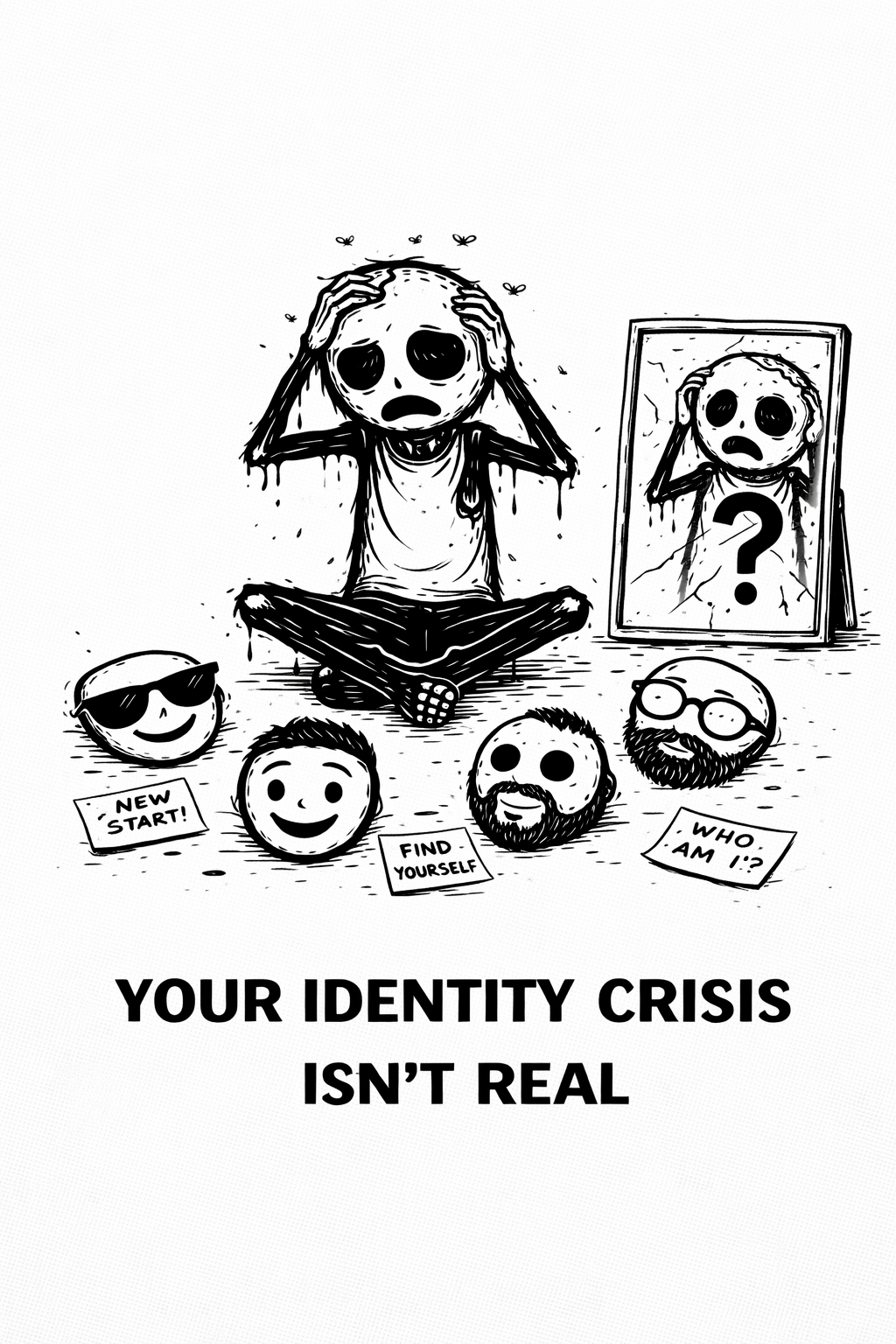
Your Identity Crisis Isn’t Real
Every few years…sometimes every few months if you’re ambitious about self-doubt, and you arrive at the same uncomfortable conclusion: you have no idea who you are. It usually happens quietly. You look at your life from a slight distance and notice things that don’t quite match the version of yourself you thought you were supposed to be. The job doesn’t feel right anymore. The hobbies feel like holdovers from a previous life. The way you talk in certain rooms feels rehearsed. You hear yourself say something and think, Who exactly is that person speaking right now?
“I’m having an identity crisis.”
It sounds serious, almost medical. Like a structural failure in the architecture of your personality. Something has gone wrong in the blueprint, you were supposed to become a coherent adult with a stable sense of self, and instead you feel like a collection of temporary versions stacked on top of each other like mismatched furniture.
But your identity crisis isn’t real.
The uncomfortable feeling you’re calling a crisis is actually the moment when the old version of you stops making sense and the new version hasn’t finished assembling itself yet. You’re standing in the hallway between two rooms, convinced the building is collapsing when in reality you are simply walking through it.
The Myth of the Stable Self
Somewhere along the way we inherited the idea that adulthood requires a fixed identity, you’re supposed to “figure yourself out.” Once you do, the assumption is that this understanding locks into place permanently like software installed on your brain. You become a certain kind of person.
You’re confident or quiet. Ambitious or relaxed. Creative or analytical. Leader or follower. Once the categories are assigned, the rest of your life is supposed to unfold in alignment with them. People expect consistency, but humans aren’t built like statues, we’re built like weather systems.
Your personality shifts depending on where you are, who you’re around, what you’re experiencing, and what you’re learning. The person who exists at work is slightly different from the person who exists with friends. The version of you that appears during stressful periods isn’t the same one that appears when life is calm.
Your beliefs evolve as new information arrives. You change jobs, move cities, and meet people who expand your worldview. You experience failure, success, and each one quietly edits the narrative of who you think you are. Still, society continues pretending that identity should remain stable and when it doesn’t, we call it a crisis. The world is dramatic when the boxes it created begin to fall apart. Crisis suggests an emergency, a panic, a system malfunction. But the thing malfunctioning isn’t you, it’s the expectation that identity should remain unchanged while everything else in your life evolves.
The Problem with “Finding Yourself”
“finding yourself” is one of the most persistent pieces of advice humans give each other. It appears in graduation speeches, self-help books, and late-night conversations with friends who are trying to sound wise while holding a drink they don’t actually like. Find yourself. Discover who you really are. Figure out your purpose.
At first it sounds noble, but it assumes something strange; that the “real you” already exists somewhere inside your brain like a hidden object waiting to be discovered. As if your personality is a treasure chest buried under layers of confusion and the entire goal of adulthood is to locate it.
What if that treasure chest isn’t there?
What if identity isn’t something you discover but something you build?
If identity were fixed, your job would be to uncover it. But if identity is constructed over time, your job becomes participation rather than discovery. When you experiment and try new things, you change directions, new experiences reveal different parts of your personality and “you” becomes a project instead of a puzzle.
The identity crisis appears when you realize the project has changed direction. Maybe the career you once thought defined you no longer fits or the interests that once shaped your personality feel outdated. Maybe the values you inherited from your family or culture no longer align with the person you’re becoming.
The old version of you begins dissolving and that dissolution can feel terrifying because identity is tied to stability, and stability isn’t real. When the story changes, it feels like the ground moved underneath you, but newsflash, the ground was always moving and you just didn’t notice before.
The Timeline Illusion
Another reason identity crises feel so dramatic is the timeline we think our lives are supposed to follow because we believe in birthdays. By a certain age, you’re supposed to know who you are. Your interests are supposed to stabilize, your career should make sense, and your relationships should reflect a clear understanding of your values.
But this timeline was invented by people who were also improvising and who also inventory astrology.
If you look closely at the lives of almost anyone you admire, you’ll notice something interesting: they reinvented themselves multiple times. The person they were at twenty-five barely resembles the person they became at forty-five. Reinvention is normal, but when it happens to you, those around you can treat it like a failure of planning. Then the identity crisis appears because the narrative you had been following suddenly stops working and the peer pressure builds and instead of acknowledging that narratives change, we panic.
One of the most underrated forms of freedom is the freedom to not have a fully defined identity. When you stop demanding certainty about who you are, you gain room to experiment. You try new skills, explore interests without worrying whether they fit the established narrative of your personality. You allow yourself to evolve without apologizing for the previous versions of yourself. Instead of protecting a fixed story about who you are, you become curious about who you might become next.
Curiosity is far more useful than certainty, because certainty freezes identity in place and curiosity allows it to grow. Your identity crisis isn’t a malfunction. It’s a signal that you’re noticing the limits of the story you used to tell about yourself. The person you thought you were is dissolving because the person you’re becoming no longer fits inside that description.
The Joshua Palms Conclusion
Your identity crisis isn’t real. Humans evolve too quickly, experience too much, and adapt too often to remain the same person for very long.
You’re not a finished character. The confusion you feel isn’t evidence that something is wrong with you. It’s evidence that your awareness has outgrown the narrative you were using to define yourself. And narratives can always be rewritten.