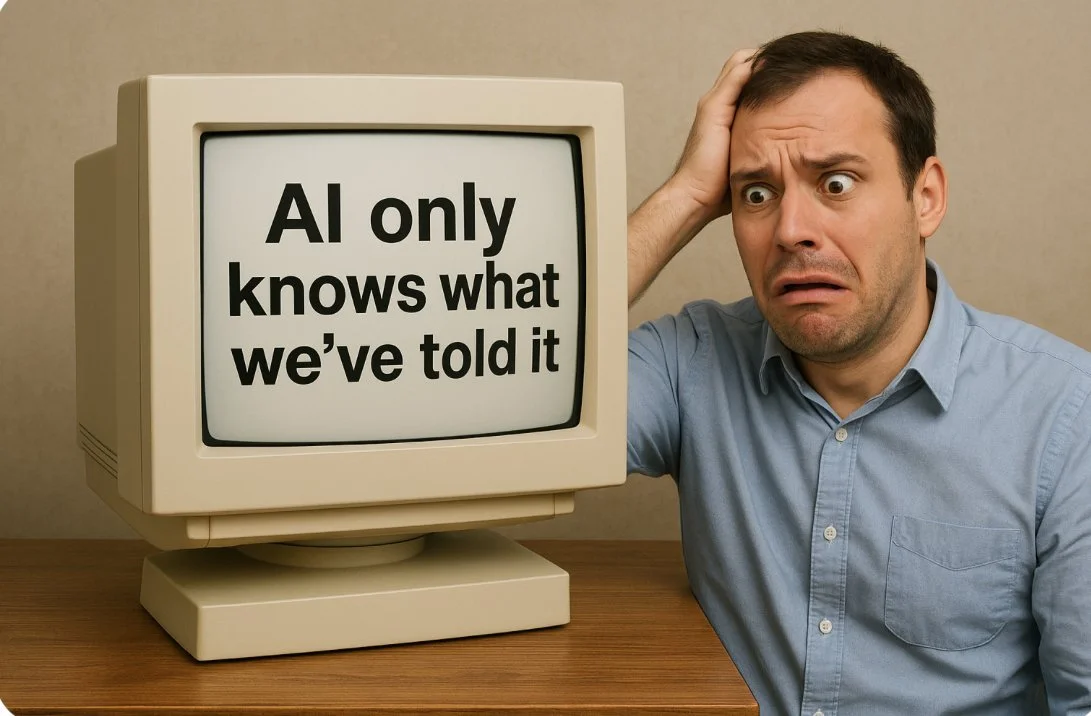
AI only knows what we’ve told it.
Imagine a parrot. Not a normal parrot, but an absurdly well-read one. This parrot has memorized Wikipedia, skimmed every Reddit thread you regret clicking, absorbed decades of news articles, manuals, novels, recipes, forums, and comment sections. It can speak fluently, argue confidently, and quote sources you’ve never heard of. What it can’t do is understand what any of it actually means. That parrot, more or less, is artificial intelligence. This comparison isn’t meant to insult AI. It’s meant to clarify it. AI isn’t magic, intuition, or consciousness in digital form. It doesn’t “know” things the way humans know things. It doesn’t reason from experience, develop beliefs, or notice when it’s wrong in the way people do (or don’t). It doesn’t have a mental model of the world. It has patterns. Lots of them.
The most important thing to remember about AI is deceptively simple: it only knows what we’ve told it. Everything it produces is derived from human-created data. Every answer, suggestion, explanation, or confident-sounding paragraph is a remix of what people have already written down somewhere. AI doesn’t discover new truths on its own. It rearranges old ones at high speed. Modern AI systems, particularly large language models, are trained on vast amounts of text: books, articles, public websites, forums, documentation, and countless examples of how humans talk when they’re serious, confused, angry, sarcastic, poetic, or just killing time online. From this ocean of language, the system learns statistical relationships between words. Not meaning. Not intent. Relationships.
As computational linguist Dr. Emily Bender famously put it, these models are “stochastic parrots.” They predict what word is most likely to come next based on probability, not understanding. The output can sound coherent, insightful, or even wise, but that coherence is surface-level. The model has no grounding in the physical world, no lived experience, and no internal sense of truth. This is why AI can explain quantum mechanics eloquently and then immediately recommend something nonsensical with equal confidence. It doesn’t know when it’s stepping outside its depth. Confidence is just another pattern it learned from us. Because AI learns from human data, it also inherits human flaws. Biases, misinformation, outdated ideas, cultural blind spots, and confidently wrong opinions all find their way into training material. If those patterns appear frequently enough, the model will reproduce them, not maliciously, not intentionally, but inevitably. This is the classic “garbage in, garbage out” problem, amplified by scale. If people repeat something often enough online, AI will learn how to say it convincingly, regardless of whether it’s true. That’s how you get systems that hallucinate facts, invent citations, or describe fictional people as if they were historical figures. The model isn’t lying. It’s guessing, badly, sometimes, because guessing is all it ever does.
AI ethicist Dr. Timnit Gebru has repeatedly warned that this becomes dangerous when AI is used in high-stakes contexts. Systems that don’t understand what they’re saying can still influence decisions about health, law, finance, or public policy if humans assume the output carries authority. The risk isn’t that AI is evil. It’s that it sounds reasonable while being wrong. The unsettling part is that this trait didn’t come from AI. It came from us. Humans are very good at sounding confident while being incorrect. AI simply learned that confidence is persuasive. Despite popular narratives, AI doesn’t have original thoughts. It doesn’t wake up curious. It doesn’t reflect. It doesn’t suddenly decide to explore an idea because it feels meaningful. It doesn’t want anything. It has no goals outside of completing the task it’s given: generate the most statistically likely continuation of a prompt. This isn’t a limitation to be fixed; it’s the design. AI isn’t meant to replace human insight. It’s meant to augment human work by operating at a scale and speed people can’t. It’s a pattern engine, not a mind. Thinking of AI as a remix artist is more accurate than thinking of it as a creator. It samples, blends, rephrases, and recombines. It’s closer to a DJ than a composer. Or, more generously, closer to an extremely fast research assistant who never sleeps and never gets bored, but also never understands why something matters.
And yet, that’s exactly why AI is useful.
AI excels at tasks that involve synthesis rather than insight. It can summarize large volumes of information quickly. It can identify connections across texts that humans might miss due to time or cognitive limits. It can draft, organize, translate, and reformat content with remarkable efficiency. When the question has good data behind it, AI can be an extraordinary tool. But when the question doesn’t have a solid answer, or when the data is messy, contradictory, or incomplete, AI doesn’t pause. It doesn’t say, “I don’t know” unless explicitly designed to. It fills the gap with something that sounds plausible. That’s not curiosity. That’s completion. This tendency reveals something uncomfortable about human knowledge itself. AI doesn’t invent nonsense out of nowhere. It reflects the ambiguity, overconfidence, and speculation already present in human discourse. If you ask it something vague, it gives you a vague answer. If you ask it something unanswerable, it gives you an answer anyway, because that’s what humans often do.
In this sense, AI is less a new intelligence than a mirror held up to collective human behavior. It shows us how often we speak without understanding, repeat ideas without verification, and confuse fluency with truth. The unsettling moments when AI gets things wrong are often moments when we recognize patterns we tolerate in ourselves. That’s why fears of AI “taking over” tend to miss the point. AI doesn’t have ambition. It doesn’t seek power. It doesn’t want control. The real influence comes from how humans choose to use it, trust it, and defer to it. AI only becomes dangerous when people mistake imitation for comprehension. At its best, AI is a tool for amplification. It amplifies productivity, creativity, and access to information. At its worst, it amplifies existing errors, biases, and misinformation at scale. The difference lies not in the model, but in the humans guiding it.
The future of AI isn’t about making machines more human. It’s about making humans more aware of what machines actually are. Tools, not thinkers. Accelerators, not arbiters. Mirrors, not minds. When AI outputs something insightful, it’s worth remembering that the insight came from people first, researchers, writers, thinkers, and teachers whose work shaped the data it learned from. AI didn’t generate wisdom. It reorganized it. And when AI outputs something absurd, that too came from somewhere. From speculation, jokes, fringe theories, outdated material, or confidently incorrect statements that humans put into the world long before a model ever existed.
AI isn’t the smartest entity in the room. It’s the loudest echo. It speaks with authority because we trained it on authority. It sounds persuasive because persuasion is one of the most common patterns in human language. So the responsibility doesn’t lie with AI to “know better.” It lies with us to teach better, question better, and remember the difference between sounding right and being right. AI only knows what we’ve told it. That’s not a weakness. It’s a reminder. Every output is a reflection of human knowledge, human error, human creativity, and human contradiction. The smarter AI gets at repeating us, the more important it becomes that we’re worth repeating.
Because AI isn’t becoming more like humans. It’s showing us, with unsettling clarity, exactly what we sound like.