Your Personality Isn’t Real.
Your Personality Isn’t Real
At some point in your life, someone handed you a summary of yourself and you accepted it like a laminated badge. You’re the quiet one. You’re the funny one. You’re the responsible one. You’re the difficult one. You’re “Type A.” You’re “bad at math.” You’re “not creative.” You’re “just anxious.” The labels stacked up slowly, politely, over years of parent-teacher conferences, performance reviews, dating app bios, and casual observations that disguised themselves as insight. Eventually you stopped questioning them. Eventually you started introducing yourself with them.
You call it your personality.
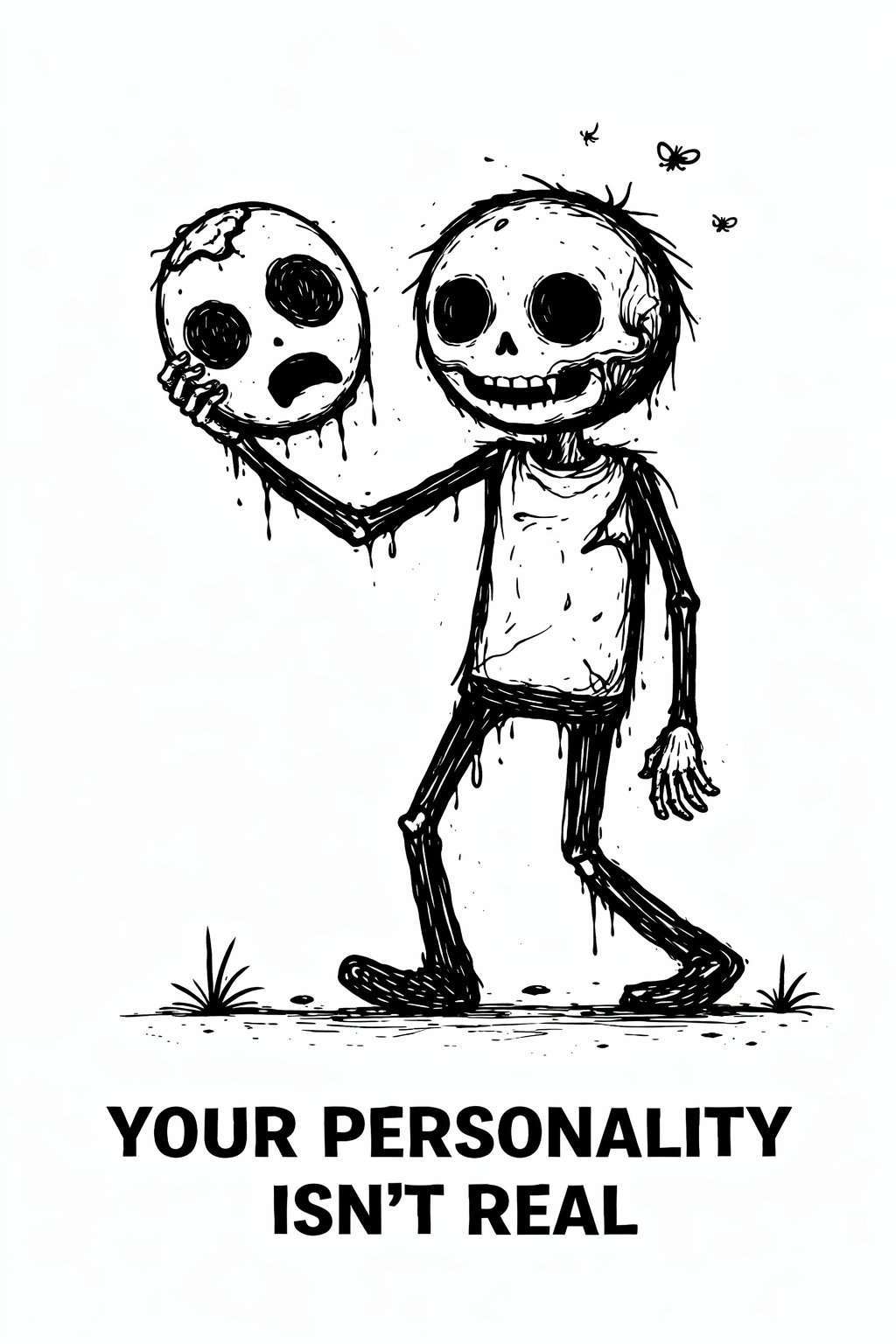
But your personality isn’t real, at least not in the rigid, museum-display way you think it is. It’s not a statue carved at birth. It’s not a fixed operating system humming beneath your skull. It’s a collection of rehearsed behaviors that worked well enough to keep you safe, liked, or unnoticed. It’s a pattern library assembled in response to environments you didn’t choose. The unsettling part isn’t that you have tendencies. Of course you do. The unsettling part is how quickly those tendencies calcified into identity. You tried being agreeable once and it reduced conflict, so you repeated it. You made a sarcastic joke in seventh grade and the table laughed, so you became “the funny one.” You expressed an unpopular opinion and the room went cold, so you archived that part of yourself and labeled it “not me.”
Over time, adaptation turned into autobiography.
You tell yourself you’re just wired this way. You say it with the confidence of someone describing eye color. You forget that most of what you call “you” is simply a survival strategy that outlived its original purpose.
The Character You Learned to Play
Imagine you are dropped into a new environment with no context. a new city or a a new job maybe. A new group of people who have never heard your backstory. For the first few days, you are fluid. You test tones. You observe reactions. You decide how much to reveal, how much to withhold, how much to exaggerate. You are not consciously crafting a persona, but you are adjusting constantly.
This adjustment is normal. It’s social. The problem begins when the version that received the most positive reinforcement becomes the only version you allow. You laugh a little louder because it makes people comfortable. You tone down your intensity because it makes you easier to digest. You amplify your ambition because it earns admiration. You downplay your ambition because it threatens someone else’s ego. Each adjustment feels small. Each one seems harmless. Eventually you look back and realize you have been playing a character so consistently that you forgot it was a role.
The Joshua Palms uncomfortable truth is this: most of what you call your personality is just branding.
Branding is repetition with confidence. Branding is choosing a few traits and broadcasting them until they feel definitive, and you do it unconsciously. You mention that you hate mornings enough times that people stop inviting you to early things. You say you’re “not the leadership type” often enough that nobody asks you to lead. You declare yourself bad at confrontation and then cite that declaration as evidence every time you avoid it. You are both the marketing team and the consumer of your own narrative.
There is a strange comfort in believing your personality is fixed. It absolves you of experimentation, justifies stagnation, and protects you from the embarrassment of trying something that doesn’t align with your established character. If you are “the calm one,” you don’t have to explore your anger. If you are “the chaotic one,” you don’t have to explore discipline. If you are “the introvert,” you don’t have to risk visibility. If you are “the extrovert,” you don’t have to risk solitude.
The box feels stable. The script feels familiar. You mistake familiarity for truth.
The Myth of a Core Self
You may argue that beneath all the adaptation there is a core, a solid center that has always been you. You might point to childhood memories, consistent preferences, or recurring themes in your life. You might say, “No, this is just who I am.” But even that core is contextual.
You’re different with your parents than with your friends. You’re different at work than at home. You’re different when you are in love than when you are heartbroken. You’re different when you feel powerful than when you feel small. Which one is the real you? The serious one? The playful one? The guarded one? The reckless one? If your personality were a fixed object, it wouldn’t shift so dramatically based on setting. The fact that it does suggests something else is happening. You are responsive, adaptive, you’re fluid. What you call personality is often just the average of your most repeated responses.
The danger of believing in a rigid personality is that it turns growth into betrayal. If you change your mind, you feel inconsistent. If you develop a new interest, you feel fraudulent. If you outgrow a friend group, you feel disloyal to a former version of yourself. You cling to old traits because they feel authentic, even if they no longer serve you. You defend your limitations as if they are sacred collectables.
There’s a quiet rebellion in admitting that your personality isn’t a prison. That It’s a draft, editable, responsive to intention. It doesn’t mean you should wake up tomorrow as a completely different human. It means you stop treating your current configuration as permanent. You say you’re “not disciplined.” What if you just haven’t practiced discipline in an environment that rewards it? You say you’re “awkward.” What if you just haven’t found spaces where your rhythm aligns? You say you’re “too much.” Too much for whom? According to what metric? Designed by which committee?
When you strip away the mythology, personality starts to look less like destiny and more like habit.
The Freedom of Fluidity
There is a reason the idea that your personality isn’t real feels threatening. If you’re not bound by a fixed identity, then you’re responsible for choosing. If you aren’t “just this way,” then you can no longer hide behind it. Fluidity is liberating, but it is also demanding. You can’t blame your “type” for every outcome or shrug and say, “That’s just me,” when confronted with patterns that are hurting you.
This is where the Joshua Palms voice leans in and whispers something slightly unhinged but deeply practical: what if you are not a personality, but a series of decisions being made in real time? Not a brand or a label. More of a sequence of choices. How you respond to criticism. How you spend your time. What you tolerate. What you pursue. What you avoid. These are behaviors and behaviors can change. When you accept that your personality is flexible, you gain access to rooms you previously declared off-limits. The “not creative” person tries painting. The “not athletic” person signs up for a race. The “not confident” person speaks first in a meeting. It feels unnatural at first because you are stepping outside the storyline you have repeated for years. It feels fraudulent because you are expanding beyond your branding. Expansion often can feel like dishonesty before it feels like growth.
You’re not betraying your true self when you evolve, you’re revealing that it was never singular. It was layered. It was provisional. It was responsive to feedback and fear and reward. When you consciously reshape it, you aren’t manufacturing something fake, you’re participating in the authorship of who you become.
The world benefits from you staying predictable. Predictable people are easy to categorize. Easy to market to. Easy to manage. When you start treating your personality as fluid, you become harder to file. Harder to summarize. Harder to reduce to a sentence. The discomfort you feel when someone says, “You’ve changed,” isn’t evidence of inauthenticity as much as it’s evidence of motion. Your personality isn’t real in the fixed, immovable sense. It is a living pattern that updates with experience, responds to courage, and contracts under fear. The more you cling to the idea of a static identity, the smaller you allow yourself to be.
So the next time you catch yourself declaring, “I’m just not that kind of person,” pause. Ask whether that sentence is a truth or a defense. Ask whether it is an observation or a shield. Ask who benefits from you staying exactly as you are. You aren’t a character trapped in a script written at birth. You’re a draft in motion, the draft can be revised, should be revised. The traits can be strengthened or softened. The tendencies can be interrupted. The narrative can be rewritten.
Your personality isn’t real in the way you think it is. It is real only in the sense that you keep choosing it. And you can choose differently.