Social Media Isn’t Real.
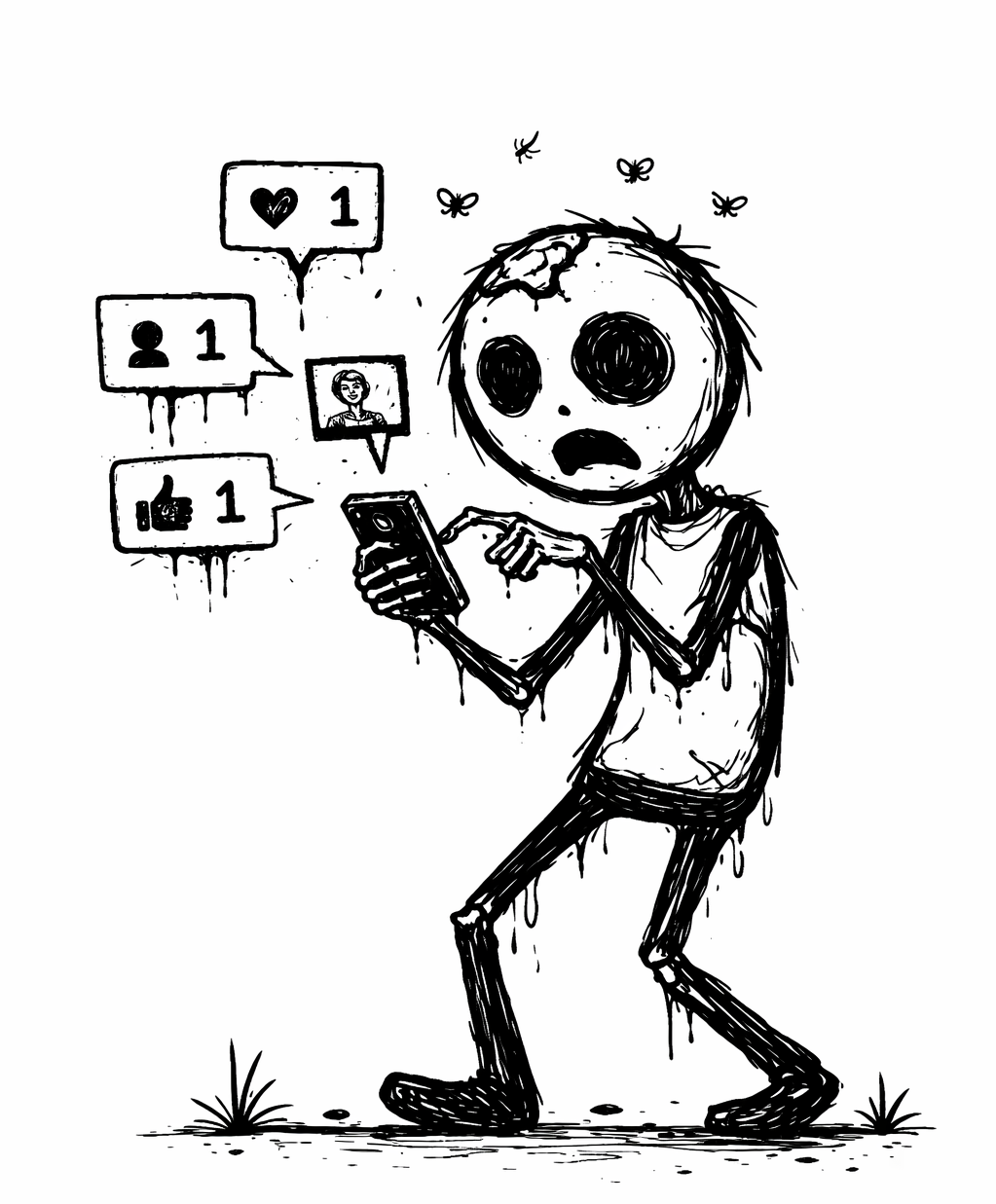
At some point, a glowing rectangle convinced you that it was a place rather than a tool. Not a distribution system for advertising inventory, not a behavioral laboratory for attention, but an actual location where life happens, where reputations are built, destroyed, and quietly negotiated while you wait in line for coffee. That’s the first and most effective illusion. Social media feels real because it borrows the surface features of real life: faces, voices, arguments, grief, jokes, friendships, romance, outrage, and solidarity. It looks like a world and behaves like a crowd, but it is not a place. It is a machine designed to reorganize human behavior around monetizable attention and then present the rearranged result back to you as if it were reality itself.
You don’t log in to see what is happening in the world. You log in to see what has been selected for you by systems that optimize for engagement, emotional activation, and predictability. What you experience as “the feed” is not a reflection of collective life; its a filtered outcome of incentives that reward volatility, certainty, and speed. Over time, that distinction becomes difficult to notice because the platform doesn’t announce its influence. It simply becomes the background environment in which your perception slowly adjusts. Social media isn’t real because it doesn’t represent the world as it is. It represents the slice of the world most likely to keep you watching.
The Feed Is a Pressure System, Not a Window
The feed isn’t neutral and it never could be. Its primary function is not to inform you, connect you, or help you understand one another more deeply. Its function is to hold your attention inside a closed loop long enough for that attention to be packaged, measured, and sold. Because of that, the feed doesn’t show you what is meaningful or accurate. It shows you what reliably triggers emotional response. Anger, fear, moral outrage, humiliation, and validation perform far better than calm reflection, uncertainty, or slow explanation, so those become the dominant emotional textures of the world you experience online.
Without ever stating its rules, the platform teaches you what kind of expression survives. You notice that careful thoughts disappear while sharp declarations spread. Nuanced uncertainty sinks while confident judgment rises. Over time, you don’t learn because you are instructed, but because you are conditioned by distribution. You begin to pre-edit your own thinking so it fits the shapes that travel well. You trim hesitation, compress complexity, and sharpen tone because the system quietly rewards those adjustments with visibility. The question that slowly replaces every other internal filter isn’t whether something is true, responsible, or even personally meaningful, but whether it will land.
That’s how a pressure system replaces a communication system. The feed doesn’t tell you what to think, but it steadily narrows the range of thoughts that feel worth expressing. In that narrowing, a subtle psychological shift takes place. You begin to experience relevance as proof of value and obscurity as failure, even when obscurity simply means something could not be flattened into an emotionally efficient package. The platform can’t monetize what it can’t standardize, and it can’t standardize what remains complicated, private, slow, or unresolved. So it trains you to become more compressible. It rewards clarity theater rather than genuine understanding and encourages you to treat expression as market testing rather than as human communication.
Your Online Self Is a Character, Not a Person
As you spend more time inside that environment, a recognizable version of you begins to take shape. A tone develops, a rhythm of opinion, a set of positions that can be defended quickly and repeatedly. It feels like identity, but it is closer to coherence. Its the construction of a legible character who can exist comfortably inside a public performance space. Real people, by contrast, are contradictory, slow to revise, shaped by private conversations, half-formed thoughts, embarrassment, grief, affection, boredom, and moments that don’t translate into content. The self that survives online must remain narratable, defensible, and recognizable to strangers.
That doesn’t make you dishonest. It makes you filtered. The longer you maintain this public-facing version of yourself, the easier it becomes to confuse consistency with authenticity. The platform rewards certainty, and certainty feels stabilizing in a world that is otherwise fragmented and overwhelming. Over time, you may find yourself defending positions you would once have explored more cautiously, not because you are rigid by nature, but because public identity carries momentum. Once spectators are present, sincerity becomes risky. Revision becomes reputational and hesitation becomes visible.
Social media isn’t real because it removes one of the most important conditions required for genuine thinking: privacy. Not secrecy, but the quiet psychological space to be wrong without humiliation, to experiment with ideas without attaching your public identity to every unfinished thought. Human reasoning evolved in small social environments where intellectual risk was buffered by familiarity and forgiveness. The feed transforms thinking into a public performance, and performance environments reward dominance, speed, and emotional certainty rather than reflection.
Attention Has Become the Environment You Live In
Humans adapt to their environments, and social media is now one of the most influential environments many people inhabit. Your brain is highly plastic, meaning it reorganizes itself around the patterns it encounters most frequently. When your daily experience consistently rewards rapid judgment, emotional activation, and social alignment, your internal habits begin to shift accordingly. You become quicker to evaluate and slower to tolerate ambiguity. You become more sensitive to social feedback and more aware of how you are being perceived than of how you are actually experiencing your own life.
An invisible audience begins to occupy your mind. You start to notice your thoughts passing through filters shaped by imagined spectators. Would this be interesting, impressive, embarrassing, or misunderstood if it were seen? That internal narrator isn’t your authentic self. Its the platform’s logic embedded in your nervous system. That’s one of the reasons people increasingly report feeling overstimulated and underfulfilled at the same time. You are exposed to enormous volumes of emotional material, but very little of it integrates into your lived experience in a way that creates meaning.
Social media collapses psychological distance. You become emotionally adjacent to events you can’t influence, conflicts you can’t fully understand, and communities you only encounter through stylized representation. Your nervous system responds as if all of it is close, urgent, and personal. Yet your capacity to act meaningfully on most of what you encounter remains extremely limited. You know more than ever, but you can do less with what you know. That mismatch produces a low-grade sense of helplessness that often masquerades as being informed.
The platform replaces participation with representation, involvement with visibility, and relationship with audience. It offers you the emotional experience of engagement without the responsibilities, risks, and depth that real participation requires. That’s why social media isn’t real. It simulates proximity, belonging, and relevance while quietly separating you from the slower, less legible processes through which real understanding and real connection actually form.
What Still Exists Outside the Feed
The parts of life that shape you most deeply remain stubbornly resistant to the logic of the feed. The conversations that change your mind without announcing it, the work that unfolds slowly over years without generating content, the relationships that deepen quietly without milestones, and the days that feel small but accumulate into a life you recognize as your own all resist compression. They do not perform well because they are not designed for spectators. They are designed for presence.
Joshua Palms isn’t arguing for digital purity or retreat into some romanticized offline identity. That’s not a call to delete accounts or perform withdrawal as a new aesthetic. It is a reminder of orientation. The glowing rectangle is not where your life is happening. Its where fragments of it may occasionally pass through. Its not your community, your thinking environment, your memory, or your self.
Social media isn’t real, but its influence is. Its cost is not primarily that it lies to you, but that it teaches you what to value without asking your permission. It quietly trains you to pursue visibility over depth, speed over understanding, reaction over responsibility, and belonging over becoming. The danger isn’t that you use it. The danger is that you stop noticing how its shaping the way you perceive, judge, and decide.
The only question that ultimately matters is one the platform can’t meaningfully represent: who are you when no one is watching, when there are no metrics to consult, no validation to collect, and no audience shaping your tone?
That person, operating in a world that still contains friction, boredom, slow growth, private change, and unfinished ideas, is real. Your life is real. It deserves better than being optimized for a scroll.